January 13, 2023
Imagine waking up and impulsively buying a car, vacuum, or even shoes before you’ve had your morning coffee. If you’re like most people, that’s probably not your style. That’s not your usual path to purchase. You don’t purchase things on a whim. You need more time to think, research, and weigh your options. Yet, when it comes to the consumer buying process, we tend to put a lot of emphasis on the final sale, even though 98 percent read online reviews before finalizing their decision—showing how every stage matters to consumers.
But that’s only one decision on the buyer’s path to purchase.
What is the consumer buying process?
The consumer buying process is the step-by-step journey shoppers take from recognizing a need to evaluating their purchase after buying. It includes every decision a consumer makes before, during, and after becoming a customer.
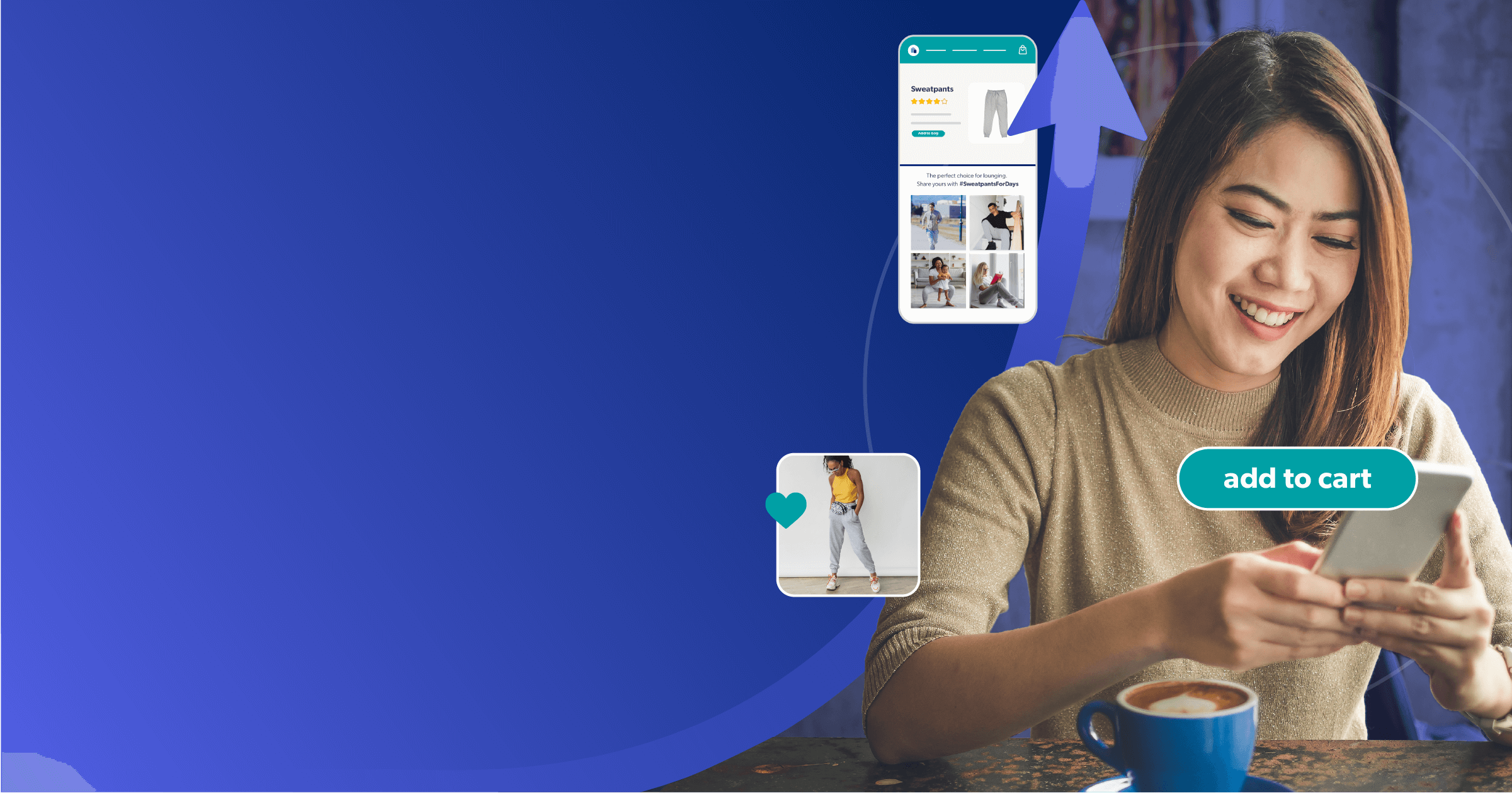
Understanding each decision in the buying process helps brands and retailers encourage shoppers to complete their purchase and build trust along the way. Learn how to boost your add to cart rate with UGC.
Why understanding the consumer buying process matters
If you want to connect with shoppers and drive sales, start by understanding their journey. Mapping your marketing to each stage of the buying process lets you:
- Provide the right information at the right time
- Build trust and remove friction
- Turn browsers into loyal customers
Key behavioral drivers at each stage of the buying process
Key factors influence shopper decisions at every stage. Here’s what matters most:
- Need recognition: Triggers like an empty pantry or a social media ad
- Information search: Trust and social proof, such as authentic reviews
- Evaluation: Price, value, and brand confidence
- Checkout: Reducing risk and making the process seamless
- Post-purchase: Satisfaction, support, and ongoing engagement
Understanding these drivers helps you meet shopper expectations at every turn.
Funnel visualization: The 6 stages of the consumer buying process
To help you visualize the path to purchase, here is a breakdown of the six stages most consumers go through. Each stage represents a critical opportunity for brands and retailers to engage with shoppers and guide them toward a confident purchase.
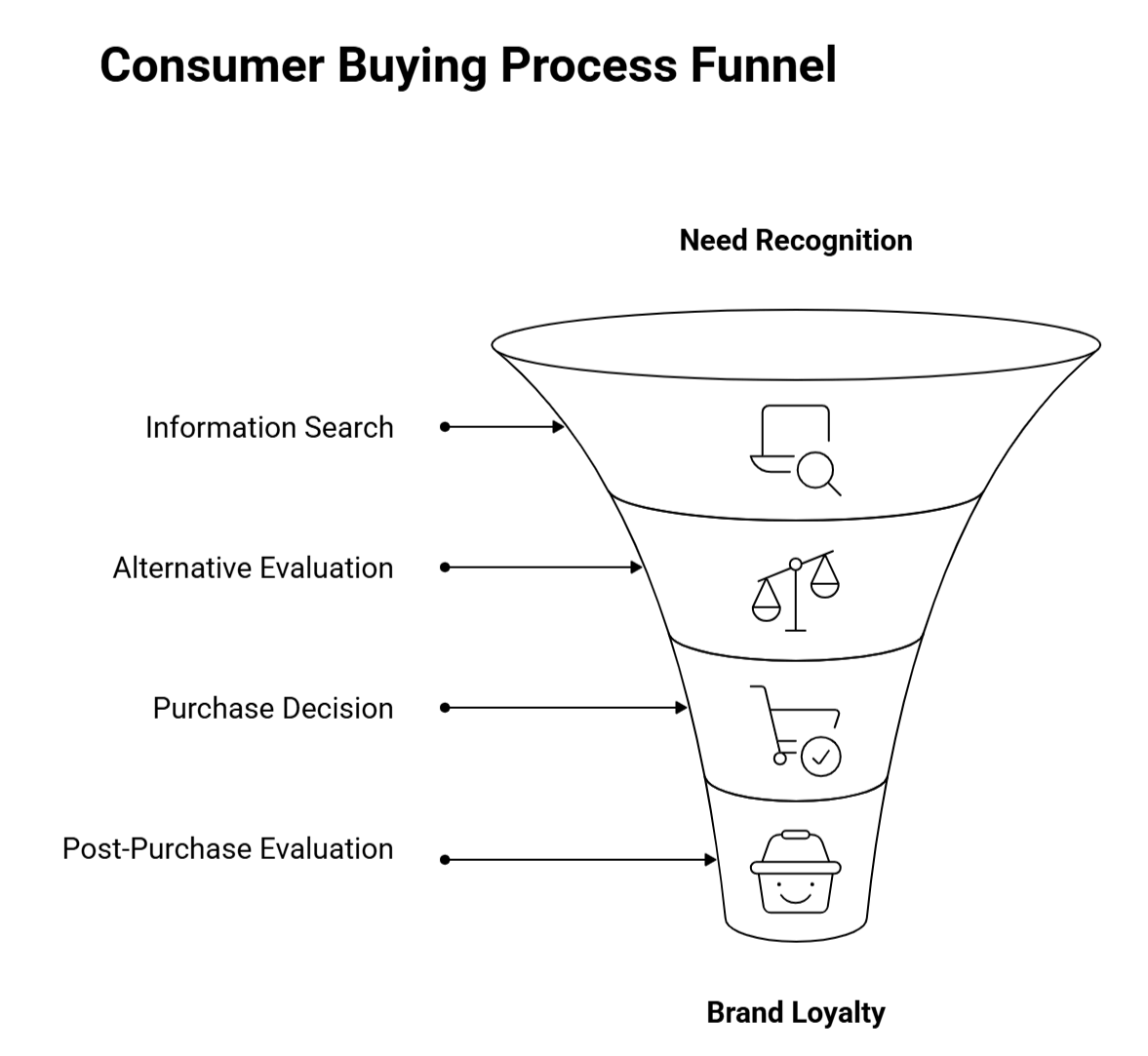
The stages of the consumer buying process
Let’s take a look at each of the six stages of the consumer buying process. We’ll discuss ways to optimize the buyer journey and ultimately boost conversion in today’s commerce landscape.
1. Need recognition
Meet Alex, a busy professional who just spilled coffee on his laptop. His buying process starts with this clear trigger: a need that sparks the journey. For many shoppers, this recognition comes from an ad, a recommendation, or a personal need.
This recognition can happen because of internal or external stimuli (grocery shopping because you need food for dinner vs. ordering takeout because you just saw an Instagram ad for pizza).
And the causes of these stimuli can be functional (purchasing a new computer because the old one doesn’t have enough processing power for Zoom calls) or social (buying new Zoom shirts to look good on your call).
Regardless, the results are the same. A want now exists.
Building brand awareness is essential at this stage, as shoppers want to support businesses that reflect their own values and beliefs and trust the brands they know—indeed, brand awareness matters: brands in the initial-consideration set can be up to three times more likely to be purchased eventually than those not considered.In fact, 82% of shoppers say they would avoid a brand if they lost trust in it.
2. Information search
Once Alex knows he needs a new laptop, he starts researching online. He reads blogs, checks product reviews, and watches unboxing videos. This is where casual browsers become buyers.
In this stage in the consumer buying process, it’s imperative to optimize your brand or retail site for search engine optimization (SEO), so you show up in search results. And given that 70% of shoppers use Instagram for product discovery, you’ll want to focus on your Instagram SEO too.
Consumers rely on information from fellow shoppers, making consumer-to-consumer recommendations a powerful influence in the buying process; in fact, two-thirds of touch points during the active evaluation phase involve consumer-driven activities like reviews and word-of-mouth.
Most brands and retailers use user-generated content (UGC) to provide authentic reviews and feedback from real customers.
Customer ratings and reviews get your brand seen and help usher people to your site through keyword-rich and relevant content. Search engines reward sites that talk in the same language as customers. So when your shoppers are actually the ones creating the content, your brand is more likely to pop up first in the search.
UGC builds trust, with 79% of consumers saying online reviews are as influential as recommendations from friends or family.
3. Alternative evaluation
Alex now has a list of options. Maybe he’s narrowed it down to three laptop models. At this point, shoppers like Alex are making a list and checking it twice. They’re aware of your brand, have been brought to your site, and are now evaluating whether to purchase from you or a competitor. It’s crunch time, and they want to make the best choice. No regrets.
So what can you do to build confidence that you have what they want? The answer again is UGC.
Ratings, reviews, Q&As, and customer photos are what consumers are turning to first to make buying decisions, and it inspires them at every step of the path to purchase. 53% of consumers say UGC makes them more confident in purchase decisions, according to our survey of over 7,000 global shoppers.
The need for authenticity is only getting stronger. And this trend is expected to flip the future of product display pages, since up to 40 percent of consumers change their minds due to something they see, learn, or do during evaluation—often influenced by authentic content.
4. Purchase decision
The shopper has read your product reviews, scrolled through the Q&A, and decided you’re the chosen one — the vendor they’ll trust with their purchase. They’ve arrived at your digital shelf. You’re in the homestretch now, right? Not so fast. You can still lose a customer at this crucial stage of the consumer buying process.
Here you should refer back to the need recognition and remind consumers why they’re buying the product in the first place. Use visual UGC on checkout pages and social channels showing products in action and pain points being solved. And make this content shoppable too. In the modern e-commerce funnel, shortening the buying process is the easiest way to drive a sale.
But should a customer leave at this stage, send out email reminders or offer slight discounts to lure them back.
According to a study by Baynard Institute, nearly 70% of shopping carts in the e-commerce industry were abandoned before checkout. This comes alongside an increase in analysis paralysis brought on by COVID-19. Simple decisions feel heavy now. Deciding what to order for dinner can feel as stressful as switching careers.
It’s up to you to alleviate this stress by making the purchase decision as simple as possible for consumers. Areas of opportunity for brands and retailers here include:
- Make your social content shoppable
- List total prices upfront so there aren’t any surprises
- Create an option for guest checkout to give shoppers an alternative to creating a personal account
- Optimize your e-commerce site for speed and reliability
- Showcase positive testimonials from reviews on the checkout page to build reassurance
- Offer quick commerce services to save shoppers the hassle of in-store pickups
5. Post-purchase evaluation
Congratulations! You’ve optimized each stage up to this point, and the product has been purchased. The consumer buying process is complete. But there’s still one more step. You now have the unique opportunity to turn the buyer into a repeat customer by keeping them engaged with your brand or store. After all, customer retention is easier and cheaper than new customers; some brands show a sixfold difference in loyalty between active and passive loyalists, highlighting the importance of nurturing post-purchase relationships.
Asking your customers for feedback on their purchases or using consumer insights found in product reviews is one of the best ways to build brand loyalty. It shows you care about their opinions and the overall experience they had with your business.
Retail giant Électro Dépôt, for example, collects UGC to encourage future buyers in their purchase decisions. The brand consistently analyzes customer feedback for areas of improvement and has since seen a 2x increase in conversion rate.
Customers are sharper than ever. And they look to their peers for unbiased opinions when making purchasing decisions — an impressive 78% of shoppers globally trust online reviews.
Understanding the consumer buying process at every stage
By considering each stage of the consumer buying process, you can implement smart strategies for your business at every point — building trust and keeping shoppers engaged at every step.
- Leverage UGC: User-generated content is the powerful tool that ties the path to purchase together.
- Mix your media: Pair UGC with branded and owned media to accelerate conversion, inspire shopper confidence, and upgrade product sentiment.
- Keep learning: Learn how you can create a 5-Star, personalized customer journey inour new on-demand masterclass.
Frequently asked questions about the consumer buying process
What are the 6 stages of the consumer buying process?
The five stages are need recognition, information search, evaluation of alternatives, purchase decision, post-purchase behavior, and brand loyalty. We include a sixth stage, completing the purchase, to address cart abandonment and optimize conversions.
How does the buying process differ for B2B vs. B2C?
The core stages are similar, but B2B buying is longer and involves more decision-makers, while B2C is faster and more emotional. UGC is especially powerful in B2C.
How can brands influence each stage of the process?
Brands can influence the journey by providing the right content at the right time, using social media for awareness, reviews for research, and customer photos for evaluation.
Why do some consumers abandon their purchase at the last minute?
Shoppers often abandon carts due to unexpected costs or a complicated checkout. Make the process simple and transparent to reduce abandonment.
How does user-generated content impact the buying process?
User-generated content builds trust and provides social proof at every stage, helping shoppers feel confident and more likely to choose your brand.