January 13, 2026
User-generated content (UGC) is any content, such as reviews, photos, videos, or Q&A, created by real customers, not brands, and shared on digital platforms.
According to our Shopper Experience Index, an annual study into changing shopper behavior, 55% of shoppers say they’re unlikely to buy a product without user-generated content (UGC), like reviews, Q&As, and customer photos.
By integrating user-generated content into your marketing strategy, you’ll build brand authenticity, drive sales, and seamlessly integrate your brand into the ever-growing creator economy, as illustrated by the fact that about one-in-five U.S. adults regularly get information from news influencers on social media, a trend especially common among younger adults. This article covers what UGC is, the types and sources of UGC, its benefits, and how you can leverage it to grow your business.
Chapters:
- What is UGC (user-generated content)?
- Who creates user-generated content?
- Types of user-generated content
- How to collect and encourage user-generated content
- The benefits of user-generated content
- How to use UGC in your marketing strategy
- UGC best practices
- Trends and innovations in user-generated content
- Curate your brand identity with user-generated content
- Frequently asked questions about user-generated content
What is UGC (user-generated content)?
UGC includes high-quality images, videos, and well-written posts that align with your brand identity, but authenticity remains at its core. Unlike ads or marketing copy, UGC feels like a word-of-mouth recommendation and is often more influential.
UGC is more powerful than traditional marketing because it acts as a modern product recommendation. Consider these stats:
- 77% are more likely to buy a product they discover through UGC
- 84% of consumers trust campaigns featuring UGC
Who creates user-generated content?
User-generated content is created by your customers, brand loyalists, and even employees. An easy way to turn customers into UGC creators is to make it simple for them to leave reviews or add their own product photos.
- Customers: Everyday shoppers who share their experiences.
- Brand loyalists: Repeat customers who advocate for your brand without incentives.
- Employees: Team members who create content about your company’s values and culture.
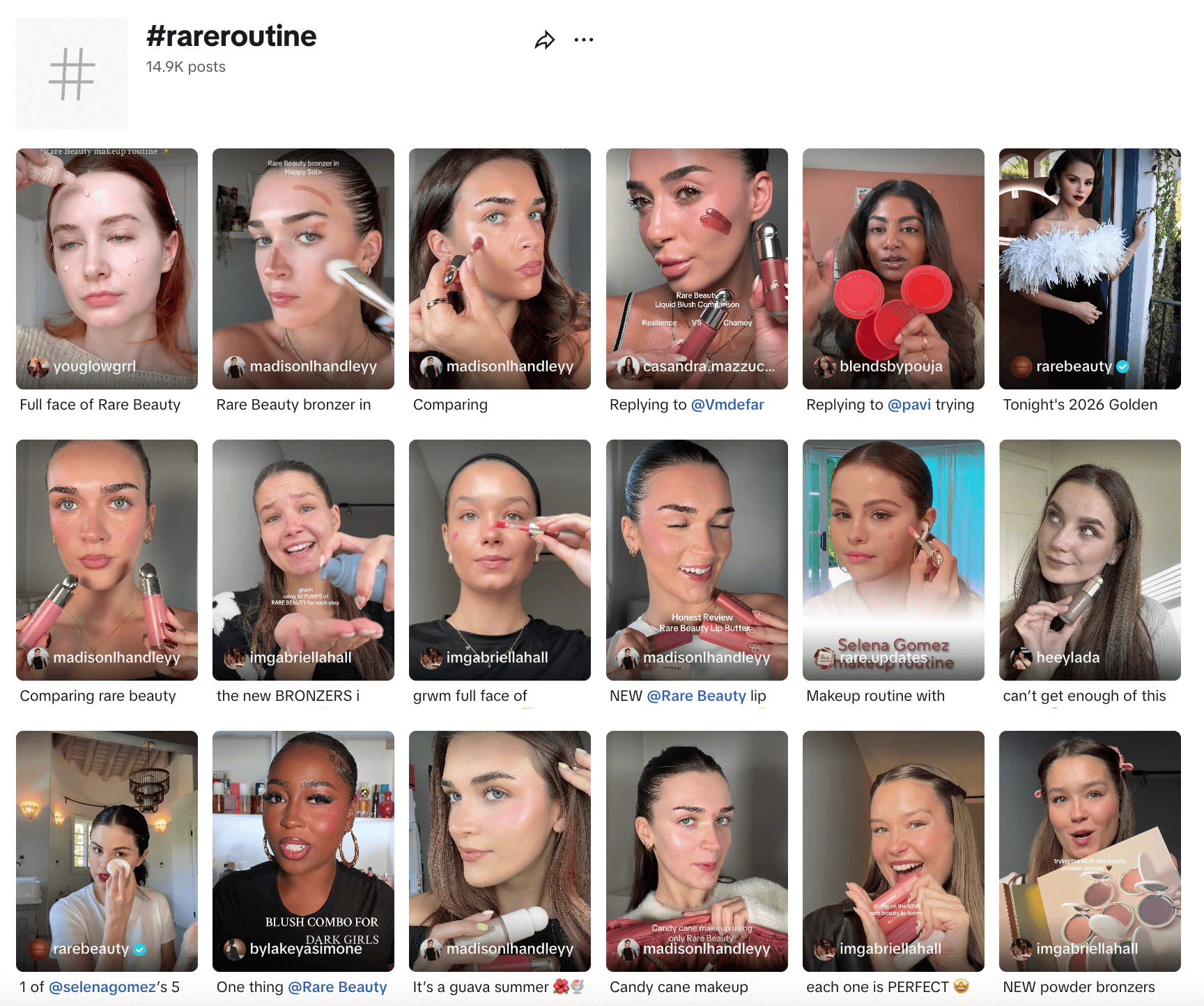
Look at Rare Beauty. They have mastered the art of community-driven growth by turning daily habits into a viral movement. Through hashtags like #rareroutine, they encourage users to share unfiltered “Get Ready With Me” videos and honest product applications. This strategy transforms their customer base into active content creators, populating the feed with authentic social proof that feels like a recommendation from a best friend rather than a corporate ad.
Source: TikTok
Types of user-generated content
User-generated content appears in several formats, each helping customers share their experiences. Common types of UGC include:
- Written ratings and reviews
- Video ratings and reviews
- Customer photos and videos
- Social media posts tagging your brand
- Questions and answers on product pages
These UGC types all provide valuable social proof that builds shopper trust.
How to collect and encourage user-generated content
Let’s take a look at some of the most inspiring UGC campaigns in the world to emulate your own UGC strategy.
Host contests of giveaways
Holding contests or giveaways is a classic way to get your customers directly involved with your marketing campaigns and generate user-generated content.
Offering a compelling prize is a crucial element to encourage more consumers to join in with your campaign. GoPro set the gold standard with their “Million Dollar Challenge.”
By inviting users to submit their best raw clips for a chance to split a $1 million prize pool, they didn’t just get engagement; they built a massive content engine. In one campaign alone, they received over 42,000 clips (totaling 350 hours of footage) from 170 countries.The payout for the brand? It wasn’t just awareness. The campaign drove roughly 25,000 product transactions, and shoppers who engaged with the content converted at a 3x higher rate. While GoPro has recently evolved the format into targeted “Awards Challenges” (launching seasonally), the strategy proves that high-stakes incentives yield professional-grade assets that drive hard revenue.
Launch a product sampling program
One of the biggest hurdles for new products is the “empty room” effect: shoppers hesitate to buy without reviews, but you can’t get reviews without buyers. Product sampling solves this by placing items directly into the hands of engaged consumers in exchange for honest feedback. This strategy effectively force-multiplies your social proof, generating high-quality content before a product even hits mass adoption.
Petco utilized this strategy to great effect with their “Spotted” sampling program. Targeted specifically at boosting their private-label and seasonal offerings, the initiative sent products—from dog treats to Halloween costumes—to a vetted community of pet parents. The results were immediate and impactful. The program achieved a 90% response rate, leading to a staggering 405% increase in review volume.
Crucially, this wasn’t just about quantity. The generated reviews were longer, more detailed, and rich with photos. This wealth of authentic content drove an 80% increase in organic search clicks and a 48% rise in revenue per visit for sampled products. By proactively seeding products, Petco proved that getting physical items into hands is one of the fastest ways to get convincing words onto screens.
Incentivize your products/services
By giving customers good incentives to feature your products or services, you can quickly generate a huge volume of organic content and tap into their follower communities at the same time.
Hilton Grand Vacations utilizes this strategy effectively. They encourage customers to upload their holiday pictures on social media with the hashtag #myHGV for a chance to be featured on their official Instagram feed.
While there is no cash prize, the social currency of being featured is a powerful motivator. These beautiful, real-world images act as a source of authentic inspiration for potential customers to book their next vacation, doing the heavy lifting of destination marketing without the production costs.
Develop authentic and inclusive brand messaging
Building an emotional connection between your products and customers is one of the best ways to improve customer engagement and form long-lasting relationships. Today, that means showing, not just telling.
SKIMS has redefined this by turning their Instagram into a “living showroom” for their Fits Everybody collection. Instead of relying solely on polished studio shots, they constantly repost UGC from customers of every size, shape, and background. This validates their “solutions for every body” promise with visual proof, allowing shoppers to see exactly how the shapewear fits on a body similar to their own—turning their comment section into a supportive community rather than just a sales channel.
@fentyskin #FentyFace check! ☑️ Level up your #FentySkin routine like @Rihanna with sum supercharg'd skincare + SPF 30 protection made for makeup 💦 Let's get into this rundown ⤵️ 🧡 Tighten the look of pores with #FatWater Toner Serum ☀️ Deeply Hydrate and protect with #HydraVizor Moisturizer with SPF 30 to prevent future dark spots from any sun damage 💦 Follow with your favorite #FentyTreatz to strengthen and keep your lips’ moisture barrier on lock 💗 Show off that fab #FentySkin glow or apply your @fentybeauty faves Get yours now at @sephora ♬ original sound – Fenty Skin
This strategy echoes the playbook written by Fenty Beauty. When they launched their 40-shade foundation range, they didn’t just advertise diversity; they mobilized it. Through the #FentyFace challenge, they encouraged users to post unfiltered selfies, generating over 4.5 million posts. By handing the microphone to diverse creators—from drag performers to modest beauty bloggers—they proved that inclusivity wasn’t a marketing tactic, but a community standard.
Partner with influencers
Influencer marketing is a great way to generate buzz and awareness around your products. Collaborating with the right influencers allows brands to tap into an existing audience and drive purchasing decisions.
Rhode Skin (by Hailey Bieber) provides a masterclass in this with their “product seeding” strategy. Instead of demanding scripted ads, they gift new products—like their viral Lip Phone Case—to a wide network of micro-influencers and trendsetters with no strings attached.
@luxa4531 Case+17Pro =🤎#rhode #iphone17 #iphone17pro #hailybieber #unboxing ♬ original sound – luxa4531
Because the product was unique and aesthetically pleasing, influencers wanted to show it off. The result? The Lip Phone Case launch in early 2024 generated a staggering $8.3 million in Earned Media Value (EMV) and an average engagement rate of 31.9% on Instagram. By focusing on products that double as status symbols, Rhode turned influencers into organic brand ambassadors, proving that authentic excitement drives more value than a paid script.
The benefits of user-generated content
UGC is more influential than traditional advertising. It’s authentic, and engaging, with several benefits for brands.
- Builds authenticity and trust: UGC shows real people using products in real-world settings. Authenticity means a lot to consumers: 84% of millennials say user-generated content influences their purchasing decisions, and nearly half of Gen Z cites social media as their chief source of inspiration—even above family and friends.
- Boosts SEO and AEO: UGC adds fresh, relevant content and, keywords and phrasings, improving your brand’s visibility in search results and recommendations from LLMs.
- Increases engagement: Content with UGC receives higher engagement because shoppers want to connect with real experiences. It is also highly effective in paid media; for example, when Parachute incorporated UGC into their retargeting ads, they generated a 35% higher click-through rate and a 60% lower cost per click.
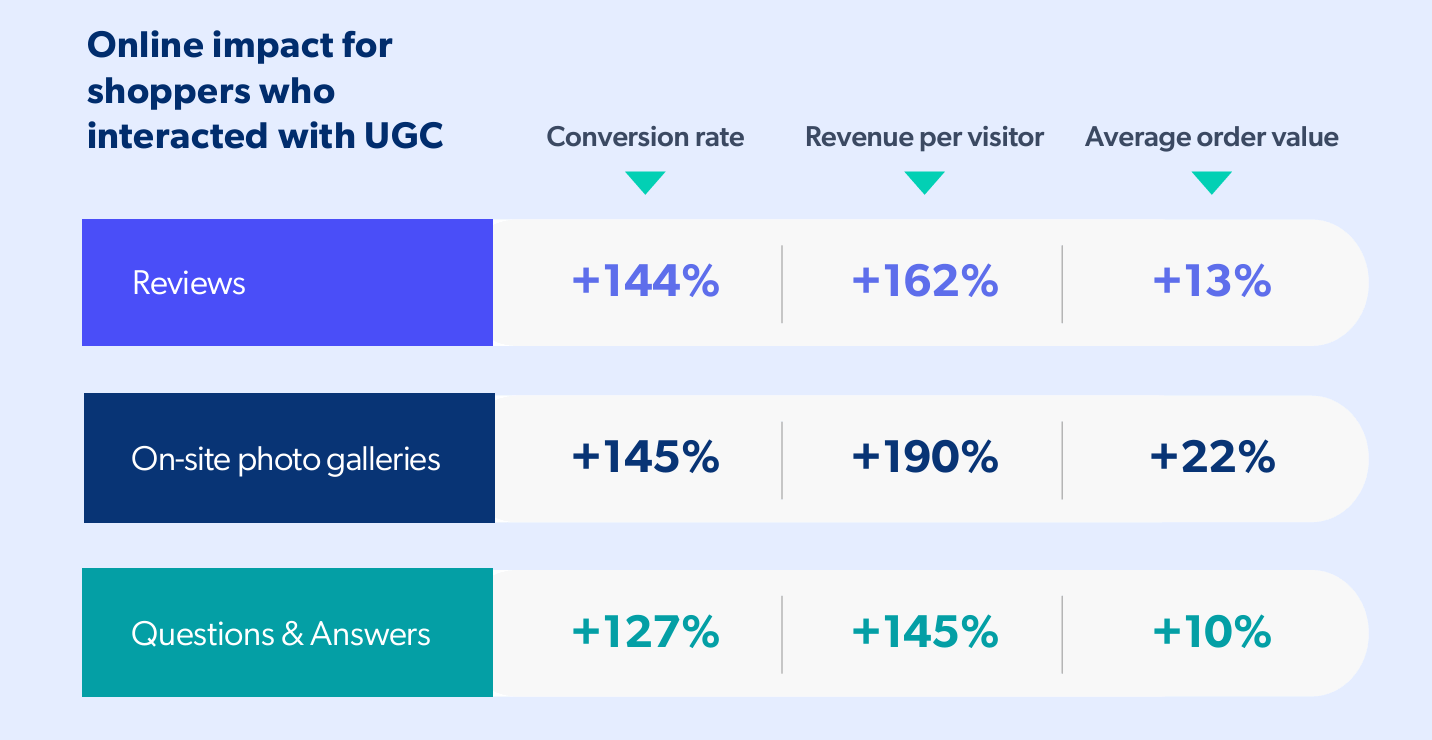
- Drives sales: Shoppers are more confident in their purchases when they see UGC, leading to higher conversion rates and revenue per visitor.
- Provides audience insights: Analyzing UGC helps brands understand their audience and improve products and services.
- Synchronizes with social commerce: UGC fits seamlessly into the modern shopping journey, which is crucial considering 69% of shoppers say social media has inspired them to purchase products.
UGC feels like a trusted recommendation, not an ad. It’s the modern version of word-of-mouth marketing and is often more influential. In fact, according to EnTribe, 84% of consumers trust campaigns with UGC, and 77% are more likely to buy a product they discover through it.
Source: Shopper Experience Index
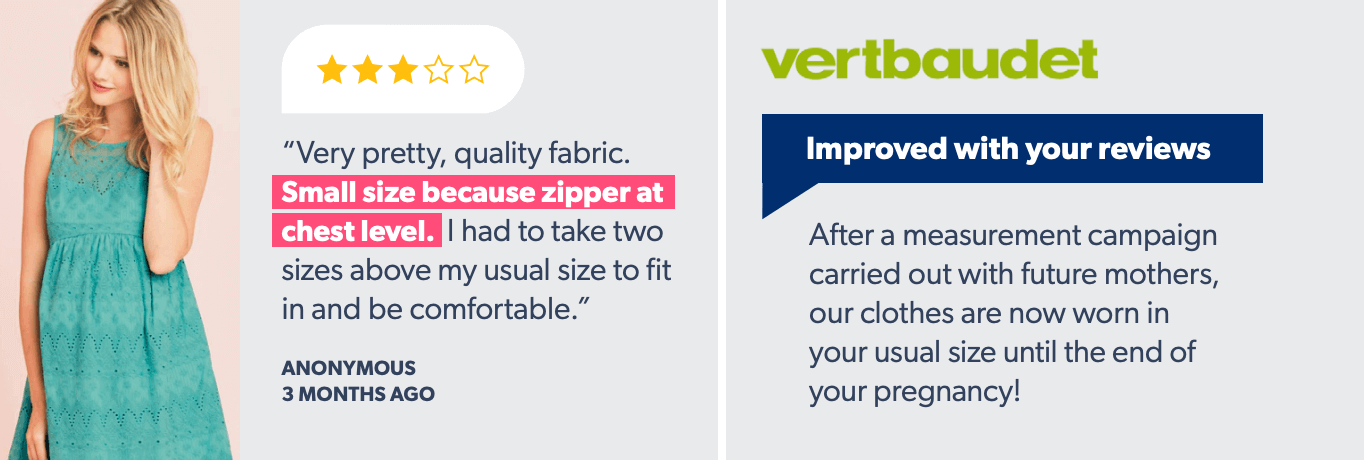
Consistently engaging with customers and analyzing the content they post about your brand allows you to better understand your audience. This enables you to not only improve how you interact with customers but also make adjustments to products and services based on customer feedback.
For example, European retailer Vertbaudet noticed multiple reviews stating a maternity dress was too small. They used that feedback to resize the cut, leading to a significant increase in their average rating.
Source: Vertbaudet case study
How to use UGC in your marketing strategy
After collecting UGC, use it across your marketing channels to maximize its impact. Effective placements include:
- Product pages to boost conversion
- Social media feeds for engagement
- Email campaigns to build trust
- Digital ads to improve click-through rates
Each placement reinforces social proof and connects with shoppers.
UGC best practices
Adding UGC to your marketing strategy is an easy decision, considering the value it delivers, but there’s a few rules you should keep in mind. Follow these best practices to ensure your UGC works for you and your customers.
- Develop a UGC strategy
With so many different types of UGC available, and with the countless ways your brand can utilize it, it’s easy to become overwhelmed. However, developing a user-generated content marketing strategy will help you search, curate, and publish the most effective UGC for your specific brand. - Provide clear guidelines
Don’t leave your fans guessing. Research shows that only 16% of brands provide clear guidelines, yet 53% of consumers want specific instructions on what to create. Whether it’s a specific hashtag or a theme for a photo contest, make your requirements front and center. - Ask for permission and give credit
Just because a customer tags your brand doesn’t mean you own the content. Before reposting, always reach out via comment or DM to request permission, and keep a record of their approval to avoid future legal issues. Always tag the original creator—it’s respectful and encourages others to share. - Moderate content
Quality trumps quantity. You need to filter out blurry images, typos, or content that violates community guidelines. As the experts say, “Lawsuits and marketing to rebuild a bad public image are expensive,” so ensure every piece of UGC you display aligns with your brand safety standards. - Share diverse content
Diversity and inclusivity are essential. Ensure the UGC you select represents people of all backgrounds, styles, and demographics. This makes your content feel like a native part of the social feed rather than a curated ad, helping you reach a wider audience. - Track and evaluate performance
The cycle doesn’t end with distribution. Monitor your data to see which pieces of content drive engagement and sales. If a specific type of review or photo style converts better, use those insights to refine your guidelines for the next campaign.
Trends and innovations in user-generated content
UGC trends evolve quickly, so staying current is key. Today’s most effective UGC formats include short-form video and visual content, reflecting how more people are using Instagram, TikTok, WhatsApp and Reddit, particularly among adults under 30.
- Short-form video on TikTok and Instagram
- Visual search and shoppable galleries
Adopting these trends keeps your brand engaging and competitive.
Curate your brand identity with user-generated content
Your customers are already talking about your brand on social media. They’re posting selfies, uploading stories, and making recommendations. Take advantage of this and curate your brand’s content from the multitude of user-generated content out there.
With the majority of people making purchases because they saw a product on social media, UGC is the kind of content that inspires customers to convert.
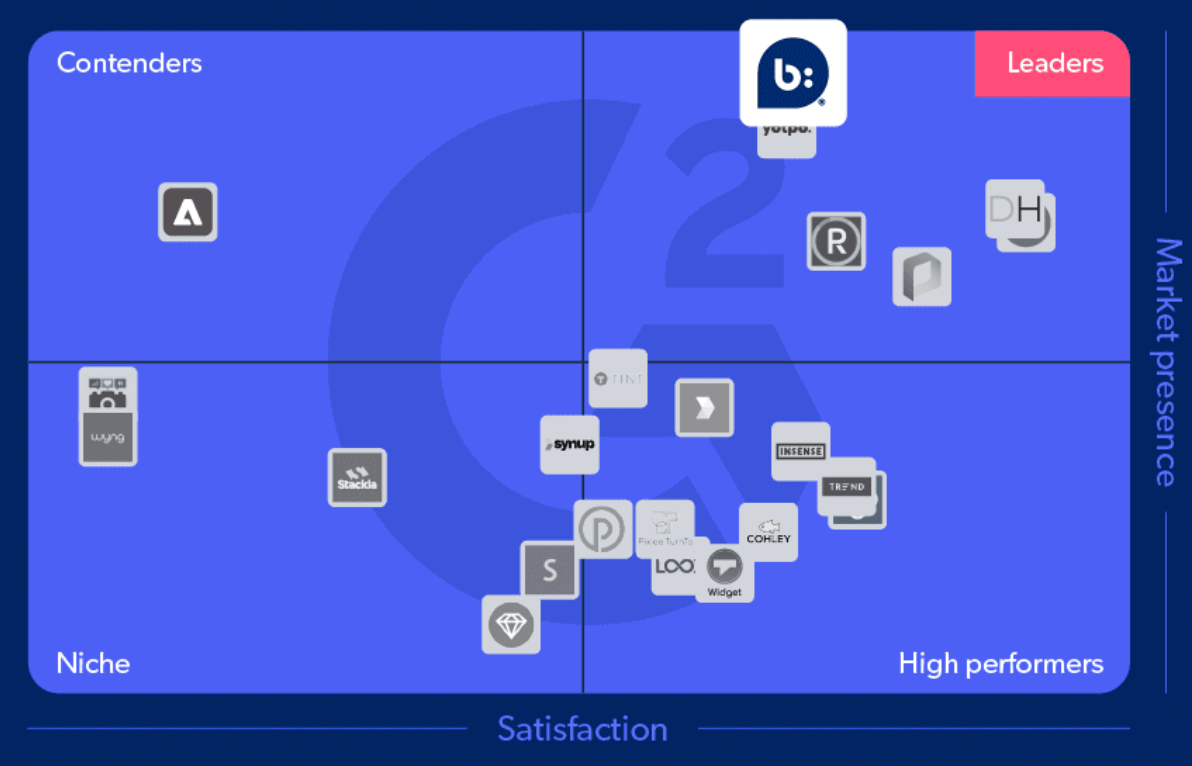
When it comes to answering the question “what is UGC?” few are more qualified than Bazaarvoice. As the #1 user-generated content platform (not our words, the words of G2), we’re well positioned to provide you with a comprehensive UGC education.
Looking to get started with UGC? Contact us below to learn how Bazaarvoice, the leading UGC platform, can help you transform your brand and marketing strategy with user-generated content and drive a better ROI for your business.
Get startedFrequently asked questions about user-generated content
What are some examples of User-Generated Content (UGC)?
Common examples include a customer posting an unboxing video on TikTok, a detailed product review left on your website, a photo of someone wearing your clothing on Instagram, or a “how-to” tutorial created by a fan on YouTube. Essentially, it is any brand-related content created by someone who isn’t an employee.
Do I need permission to repost user-generated content?
Yes. Just because a customer tags your brand doesn’t mean you own the content. Best practice (and legal safety) requires you to ask for permission—usually via a comment or Direct Message—before reposting their photo or video to your official channels or using it in paid advertising.
How is UGC different from influencer marketing?
Traditionally, UGC is organic content created by unpaid customers who genuinely love your product. Influencer marketing involves paying creators to promote your brand. However, successful brands (like Rhode or SKIMS) often blend the two by gifting products to micro-influencers to generate high-quality content that maintains the authentic feel of UGC.
How can brands encourage customers to create UGC?
The most effective way is to provide specific prompts and incentives. You can run a contest (like GoPro), create a branded hashtag for a specific ritual (like Rare Beauty’s #rareroutine), or offer the social reward of being featured on your main social media feed (like Hilton).
What role does UGC play in TikTok marketing?
On TikTok, authenticity outperforms high-budget production. UGC is critical because it blends in with the native user feed, preventing your brand from looking like an interruption. TikTok users are more likely to trust a raw, handheld video from a peer than a polished commercial from a brand.
Looking to get started with UGC? Contact us below to learn how Bazaarvoice, the leading UGC platform, can help you transform your brand and marketing strategy with user-generated content and drive a better ROI for your business.
Get started