
February 19, 2024
Ever since The Terminator was released back in 1984, there’s been slight apprehension surrounding artificial intelligence (AI). But it’s been a part of our lives for years, whether we’ve realized it or not. AI is becoming increasingly common in the world of e-commerce, with 89% of companies either actively using AI or testing it via pilot programs. And you know what, John Connor hasn’t come back to warn us against it.
Since the early 20th century, automated systems have helped power commercial airplane autopilot functionality and modern AI now builds on those foundations. Today, spam filters, mobile check deposits, and facial-recognition technology all use AI to make consumers’ lives easier.
And in e-commerce, AI is used to improve website search functionality and make better recommendations based on recent browsing activity. The technology also helps power retargeting ads and chatbots.
Now, leading brands and retailers are tapping this technology to improve the shopping experience for customers in innovative new ways. Thanks to the growth of AI in e-commerce, shopping from home, in the park, or literally anywhere you have an internet connection, just got a whole lot more exciting.
Awesome ways AI is impacting e-commerce
AI is transforming e-commerce by enabling brands to personalize shopping experiences, automate operations, and make data-driven decisions. The most impactful use cases include product recommendations, chatbots, predictive analytics, and dynamic pricing, all of which help brands increase efficiency and drive sales.
1. Endless personalization
Oh, personalization. The hot topic that’s taken consumer demands to another metaverse while forcing retailers to ask themselves, “Do I really know my customers as well as they want me to?”
Personalized shopper journeys are now expected by customers, and 7 in 10 shoppers say they want smarter, more personalized shopping features. AI algorithms analyze large amounts of data to reveal:
- Customer behavior
- Preferences
- Shopping trends
These insights help brands make smarter decisions and tailor their offerings to each shopper.
The result? A bucket load of customer satisfaction, increased engagement, and higher revenue. Personalization has also been proven to strengthen brand loyalty — 70% of consumers say that how well a company understands their individual needs impacts their loyalty. Give them what they want (personalized, relevant experiences), and watch their support grow.
You can’t talk about e-commerce personalization without mentioning its compatriot, AI-generated product recommendations. These subtle suggestions can create quite the shopper stir when delivered at the right time and in the right way.
AI algorithms analyze browsing and purchase history to identify shopping patterns. This data powers product recommendations that drive more sales—AI product suggestions account for 35% of Amazon’s revenue, and personalized recommendations enhance conversion by an average of 10–15%.
Remember that important customer data we previously mentioned? AI systems can use it to identify relevant cross-selling and upselling opportunities. Even better, AI has a large capacity to learn and adapt, which means that over time you’ll be able to maximize your supplementary sales, propelling and improving your customer lifetime value.
2. It enhances the customer experience
One of the most meaningful ways AI is evolving e-commerce is by providing marvelously-engaging customer shopping experiences. From the very first search to the final post-purchase adieu, AI enables your digital store to function in a way that makes each shopper feel like it was created just for them.
AI-powered search uses machine learning to improve product discovery, making it easier for shoppers to find exactly what they need. For example, visual searches increased by 70% globally in the past year.
AI uses natural language processing (NLP) to make shopping faster and more intuitive. By combining keyword and vector search, results are more accurate and relevant. Shoppers benefit from:
- Voice search for quick, hands-free queries
- Visual search to find products using images
- Voice search. This well-known speech recognition technology allows shoppers to search phrases quickly without using a mobile device’s keyboard. Thanks to emerging AI, voice commerce has seen some impressive upgrades. For starters, speech analysis and contextual reasoning have led to more accurate voice recognition. It also saves customers time by reducing the effort (and chance for errors) of manual typing — handy for lengthy product names like, “Organic Queen Size Memory Foam Lavender Scented Pillow”.
- Visual search. Sometimes, a shopper wants to find a product but doesn’t know its name, type, or the category it falls under. Usually, it’s right about here that their search journey ends. But with visual search, potential customers can look for products using images and nothing else. If an online visitor doesn’t know the details of an item they’re interested in, all they need to do is use a picture to find what they’re searching for. Not only does this increase product exposure, but it elevates the customer experience by alleviating the friction between curiosity and acquisition.
Both augmented reality (AR) and virtual reality (VR) enhance the e-commerce experience by providing immersive and responsive features that minimize the gap between online and physical (phygital) shopping.
Maybe it’s because AR integrates simulated elements with the real world, enabling shoppers to engage with products in their own surroundings. Or maybe it’s because AR can seamlessly work with existing devices, so shoppers can experience a product from their iPhone or tablet. Either way, the global AR market is expected to reach $300 billion this year.
Shoppers can try on virtual products, see how items will look and fit in their space, and participate in interactive demonstrations. AI also enables retailers to offer tailored recommendations and personalized offers.
One of the most significant ways AI is transforming e-commerce is through improved customer service. Most e-commerce businesses don’t have time to compose a personalized response to every incoming inquiry. This is where artificial intelligence can really serve a purpose.
80% of retail and ecommerce businesses use AI chatbots or plan to use them in the near future, enabling online retailers to provide 24/7 support to their customers. And because they never take breaks or get heated, chatbots can provide a level of service humans can’t match up to. Did we mention they don’t get paid either?
Chatbots use NLP to understand customer queries and provide immediate, accurate responses. They help shoppers make decisions and assist with order tracking and returns.
Did you know that the average cart abandonment rate is around 70%? The good news is that AI can help to decrease the number of lost customers during the checkout process, with proactive approach conversations resulting in 35% recovery rates.
AI algorithms optimize the checkout flow by assessing customer behavior and preferences to determine if any recommendations or messaging is needed for that final purchasing persuasion.
Machine learning can also save shoppers time by inputting customer information, and offering advanced support by providing effortless payment processing. Together, this creates a more streamlined shopping experience that can minimize cart abandonment and maximize conversion rates.
3. It improves business operations
There’s a lot that goes on beyond what a shopper sees on their device’s screen. AI makes managing the back-end of e-commerce easier by providing tools that boost efficiency, save on costs, and help online retailers know exactly who to market to.
The use of AI in e-commerce empowers businesses to automate several procedures that are usually performed manually. By utilizing this innovative technology, online retailers can diminish their time spent on repetitive and arduous tasks, such as packaging items, restocking shelves, and troubleshooting issues.
The best part? The more AI software is introduced, the more its capabilities improve, resulting in a revolving loop of productivity.
AI and machine learning streamline repetitive tasks, reducing operational errors. This allows your team to focus on creative work that drives business growth.
AI-driven, predictive analytics tools can examine enormous volumes of customer data to forecast market trends, potential risks, and future opportunities— 65% of senior ecommerce executives believe AI and predictive analytics are key to their growth strategies. These insights enable you to make informed decisions and customize your sales and marketing strategies to better align with shopper preferences.
Predictive analytics also support supply chain management by forecasting demand and optimizing inventory.
AI makes it easier to hyper-segment audiences using data such as:
- Browsing history
- Life stages
- Major hurdles or pain points
This helps retailers understand customer preferences, behaviors, and sentiments.
This allows businesses to tailor marketing and sales offers to specific shoppers, improving targeting and ROI.
4. Superior supply chain management
AI is modernizing the e-commerce industry by providing greater automation in supply chain management—AI demand-forecasting can improve inventory accuracy by about 35% and lower logistics costs by 15%. Predictive analytics can help optimize stock levels, streamline delivery routes, and forecast potential disruptions. Here’s a quick breakdown for you.
Many online retailers rely on artificial intelligence for sales predictions to make demand forecasts more precise. Instead of using historical data, AI software makes sales and demand predictions using real-time data like weather, demographics, and online reviews, to name just a few. This allows you to adjust inventory levels and enhance operational adeptness.
Good inventory management focuses on monitoring stock levels to ensure the right supply is always available to meet customer demand.
AI helps e-commerce stores maintain adequate inventory levels by utilizing data such as sales trends from previous years, projected changes in product demands, and impending supply-related issues that could affect stock availability.
And unlike pesky humans, AI robots can be used 24/7 to dispatch items immediately following an order, fetch inventory, or stockpile merchandise.
AI-powered dynamic pricing lets e-commerce businesses adjust their pricing based on supply and demand.
Using data analytics and more machine learning methods, AI algorithms evaluate market trends, customer behavior, and competitor pricing to determine the best price for any product.
Dynamic pricing algorithms can then adjust prices in real-time to enable digital retailers to boost revenue and maintain a competitive edge.
Types of AI tools used in e-commerce
Understanding the different types of AI tools available is the first step to harnessing their power. For example, a 2025 ecommerce trend analysis highlights product recommendations, inventory management, and AI agents as common active themes in the industry. For e-commerce managers and marketers, these solutions are designed to solve specific challenges, from personalizing the shopper journey to streamlining operations. Here are the key AI tools transforming the digital shelf.
- Recommendation Engines: These tools use machine learning to analyze shopper data—like past purchases and browsing behavior—to suggest relevant products. The result is a more personalized experience that increases average order value and keeps customers engaged.
- AI-Powered Chatbots: Chatbots and virtual assistants provide 24/7 customer support, answering common questions about orders, returns, and products. By using natural language processing (NLP), they offer instant, helpful responses that free up your support team for more complex issues.
- Predictive Analytics: This type of AI forecasts future trends, customer behavior, and inventory needs by analyzing historical and real-time data. It helps you make smarter decisions about marketing campaigns, stock levels, and pricing strategies, ensuring you stay ahead of the curve.
- Visual and Voice Search: Visual search allows shoppers to find products using an image, while voice search lets them use spoken commands. Both technologies make product discovery more intuitive and accessible, reducing friction and improving the overall customer experience.
AI in e-commerce brand examples
AI is already well underway and brands are taking note, as the AI-enabled ecommerce market was valued at $7.25 billion in 2024 and is projected to grow to $64.03 billion in 2034. Here’s some of our favourite brand examples of AI in e-commerce.
Playing makeup at home
One of the best arguments for using AI in e-commerce is trying on items — virtually. NARS Cosmetics’ virtual try-on uses a shopper’s camera to instantly detect the contours of the face. As shoppers click on shades of lipstick, bronzer, and eyeshadow, the makeup is superimposed on their lips, cheeks, and eyes.

Occasionally a set of bright red lips appear in the middle of the screen, but the experience is surprisingly smooth and accurate. The technology also automatically evens out shoppers’ skin tone, making the makeup extra flattering.
Home sweet (virtual) home
Target’s See It in Your Space tool uses AR to allow shoppers to literally see how furniture and decorations will look in their home. Shoppers can either upload a photo of a room or use the Target app to access their device’s camera. Then, they select furniture to overlay on the image.

The tool helps them see if items will fit in the space, coordinate with other items, and decide which finish or color works best.
Taking ‘see it for yourself’ to another level
Eyewear brand Warby Parker was an early adopter of AR. Its app allows shoppers to see how each frame will fit their face.

The brand’s Virtual Try-On feature also won a Webby Award. Shoppers can click through different styles and colors to see which best complements their face shape. Once they’ve picked their favorites, Warby Parkers allows shoppers to select 5 frames to try on at home for free.
H&M’s personal stylist
H&M use an AI chatbot as their own personal shopping assistant. The bot learns each shopper’s style preferences through a series of questions, then presents options to the shopper to choose from.
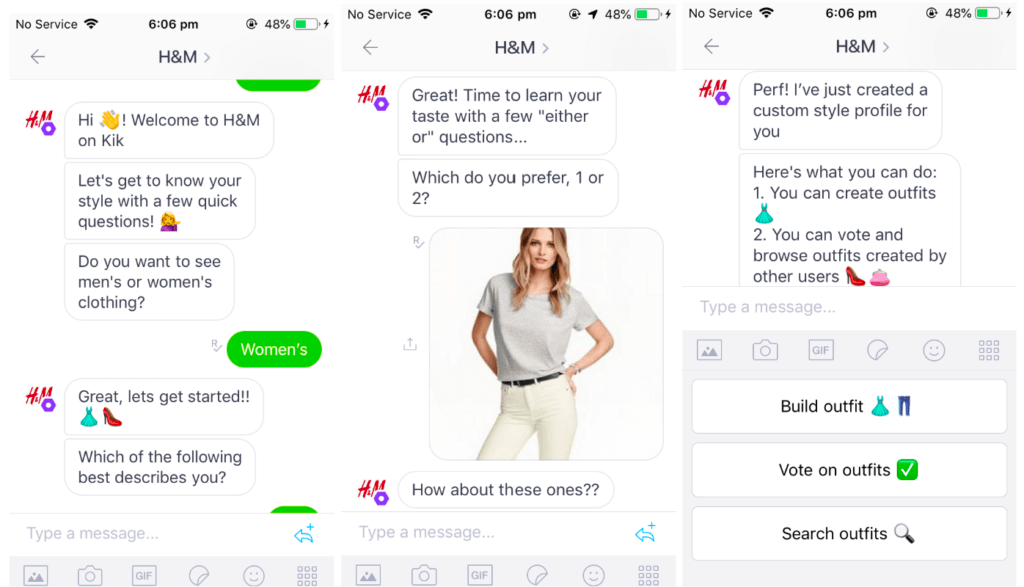
Based on continual feedback from the shopper, the chatbot continues to offer up new suggestions, advice, and products for them to purchase.
3D luxury
Consumers looking for a new designer handbag or wallet can now view 3D images of their favorite Burberry products online. The items are scaled to size and then superimposed on the shopper’s camera screen.

Consumers can then see what a purse looks like on their shoulder or countertop and see how it complements their favorite outfits.
How to optimize your AI in e-commerce strategy
AI is clearly here to stay. Whether it’s transforming e-commerce by delivering endless personalization, enhancing the overall customer experience, or improving company operations, the AI revolution is changing the way we do business. But don’t forget: AI is here to enhance, not replace.
Ready to unlock the power of AI for e-commerce? Bazaarvoice Insights and Reports tools seamlessly integrate AI to boost efficiency and optimize your marketing strategy. Whether for boosting sales, improving products, or competitor analysis, our tools have you covered.
Emerging trends and the future of AI in e-commerce
The evolution of AI in e-commerce is moving faster than ever. Staying ahead of the curve means understanding where the technology is headed. Here are the key trends shaping the future of online retail and how your brand can prepare for what’s next.
- Generative AIfor Content and Commerce: Generative AI is set to revolutionize how brands create product descriptions, marketing copy, and even visual content. This technology can produce high-quality, personalized content at scale, helping you engage shoppers with unique and relevant messaging across your entire catalog.
- Hyper-Automation in Operations: Beyond simple task automation, hyper-automation will connect and optimize entire workflows, from inventory management to order fulfillment. This will lead to unprecedented efficiency, fewer errors, and a supply chain that can adapt in real-time to market changes.
- Ethical AI and Transparency: As shoppers become more aware of how their data is used, transparency will be key. The future of AI in e-commerce will focus on ethical practices, giving customers more control over their data and building trust by being open about how AI-driven personalization works.
Frequently asked questions about AI in e-commerce
Can AI build an e-commerce website?
AI can generate basic layouts and content, but it can’t build a fully functional, complex e-commerce site from scratch.
What are the main challenges of implementing AI in e-commerce?
Key challenges include data quality, privacy, integration with existing systems, and having the right expertise.
How do I choose the right AI tools for my e-commerce business?
Identify your biggest challenge, such as personalization or inventory management, and select a tool that addresses it. Choose solutions that integrate with your current systems and deliver measurable results.
How can I measure the ROI of AI in e-commerce?
Track KPIs like conversion rates, average order value, and cost savings before and after implementing AI to measure impact.
What are the first steps to get started with AI in e-commerce?
Start with a clear business goal and clean data, then launch a pilot project to test and measure AI’s impact before scaling.