July 20, 2026
Ask a friend how they research a product these days, and there’s a good chance an AI tool is part of the story. They ask a chatbot to compare a couple of options, skim an AI shopping summary, or let a search engine’s AI overview handle the first round of shortlisting.
Your shoppers are doing the same thing, and that changes what “good content” means for your brand.
For years, product proof lived mostly in one place: your own website. Reviews, ratings, and detailed descriptions all sat on brand.com, tuned to convert someone who was already there. But if that’s the only place your proof lives, it’s not reaching shoppers, or the AI tools helping them decide, anywhere else.
Your product proof needs to travel further than your product page.
AI visibility is not just an owned-site challenge
For years, e-commerce teams treated their website as the finish line: get the product page right, and the reviews, specs, and imagery all pull double duty, converting the shopper who’s already there.
That’s still true. It’s just not the whole story anymore.
If you’re mapping out strategies to improve your brand’s visibility in AI search engines, off-site proof is where to start. AI platforms lean heavily on third-party, off-site content when they put an answer together.
McKinsey found that only 5% to 10% of what AI platforms reference comes from a brand’s own website, with the remaining 90% to 95% pulled from third-party sources. Muck Rack’s research tells a similar story: 94% of AI citations trace back to earned, third-party content rather than brand-owned domains.
Category-specific research backs this up too. University of Toronto researchers studying generative engine optimization, or GEO, found that over 93% of citations from Claude and ChatGPT in consumer electronics came from earned media and third-party sources, with a similar pattern showing up in the other categories they tested.
Here’s what that means in practice: if a product has hundreds of five-star reviews on your website but no review coverage on the retailers AI tools are actually referencing, your AI visibility footprint is thinner than your review volume suggests.
Ahrefs’ analysis of 75,000 brands adds another data point: branded mentions that live off your own domain have the strongest correlation with AI Overview visibility of any factor studied, roughly three times stronger than standard backlinks.
None of this means your website stops mattering. It’s still the foundation. But it can’t be the whole strategy. If your proof only lives in one place, AI systems don’t have much corroborating evidence to work with.
Why retailer domains matter in AI shopping
Retailer sites and marketplaces earn a kind of trust that’s hard to replicate anywhere else. They’re where shoppers compare products side by side, read a range of reviews, and sanity-check a purchase before they commit. AI shopping tools tend to look in the same places.
A BrightEdge analysis found that 36% of product-related ChatGPT responses cite retailer domains directly, making retail sites the most commonly cited source type for shopping queries on that platform.
Google AI cites retailers far less often by comparison, a reminder that AI platforms don’t all draw on the same sources the same way. Google’s own AI shopping experiences pull from the Google Shopping Graph, a database of more than 50 billion products that Gemini and AI Overviews reference in real time to answer shopping questions.
AI tools favor retailer domains for a straightforward reason: they carry established authority and clean, structured product data. When an AI shopping assistant looks for evidence to back up a recommendation, a well-populated retailer page is easier to trust than a single, isolated source.
If your brand doesn’t have strong review coverage there, you’re not just leaving conversions on the table. You’re less likely to show up in the research AI tools do before they make a recommendation.
Reviews are no longer just conversion content
It’s worth rethinking what a review is actually for. For a long time, reviews sat near the bottom of the page, useful, but treated mostly as a trust signal that nudged an already-interested shopper toward checkout.
That undersells what reviews do.
Reviews carry real customer language: how people actually describe a product, what they compare it to, what nearly stopped them from buying. That’s exactly the kind of detail AI tools look for when they’re trying to understand a product beyond its spec sheet.
When a product has strong, current reviews spread across the places shoppers already research, you’re giving both humans and AI systems more of what they need to trust a recommendation.
What review syndication means in the AI era
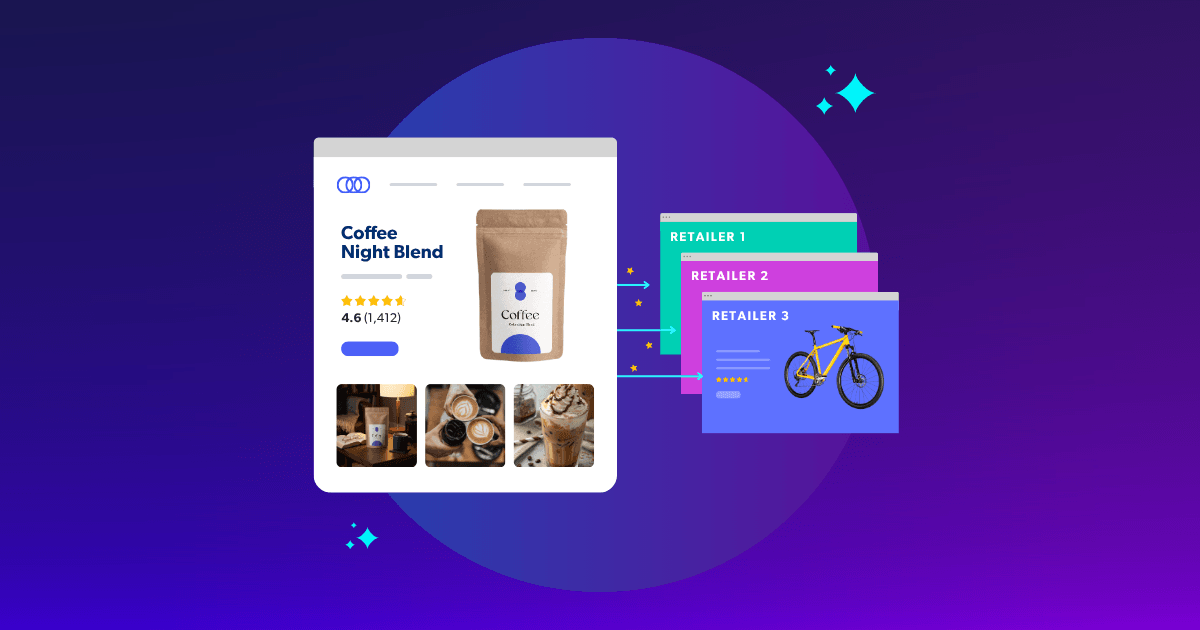
Review syndication itself isn’t new. It’s the process of taking verified reviews collected on your site and distributing them to your retail partners, so the same authentic content shows up on their product pages too.
The original case for syndication still holds: it extends your retail reach, fills in thin or empty product pages, and supports conversion where your customers are actually shopping. What’s changed is what else that reach can do.
We can’t say syndication guarantees a spot in an AI answer. No one can promise that yet, and any brand claiming otherwise is getting ahead of the evidence. But the logic holds up: syndicating your reviews puts the same authentic content across more of the third-party destinations AI systems already lean on.
Research from Stacker and Scrunch found that citation rates rose from 7.6% for content that lived only on a brand’s own site to 34% for the same content distributed across multiple third-party sites, a 4.4x lift. That study looked at editorial content rather than reviews specifically, but the underlying mechanism, more independent domains carrying the same proof, is the one syndication puts to work.
Syndicate the same, accurate product data, matched carefully at the product identifier level, across your retail network, and you help make sure that whatever AI systems find when they go looking for proof, it points back to your product, not a gap.
How to spot your review syndication coverage gaps
Before you can close a gap, you need to see it. Here’s a practical way to check how your product proof is really showing up across the digital shelf:
| Action | What to check |
|---|---|
| Map your coverage | Audit priority SKUs across your owned site and key retail partners to see where review volume is strong, thin, or missing entirely. |
| Spot the on-site vs. retailer gap | Find products with strong reviews on your website but little to no presence on the retailers that matter most. |
| Prioritize by impact | Start with high-margin, high-traffic, and new-launch SKUs, where a visibility gap costs you the most. |
| Fix thin content before you syndicate it | Use sampling or review generation to build up weak review sets first. Syndicating thin content just spreads the gap further. |
| Check your data quality | Clean, accurate product identifiers and matching are what make syndication actually work across a multi-retailer network. |
| Reframe what a gap costs you | A missing retailer review set is not just a conversion gap. It is a gap in the off-site proof AI tools look for, which makes it a visibility gap too. |
| Watch, don’t over-attribute | Keep an eye on how products show up in AI search and shopping tools, without assuming every change traces back to syndication alone. |
None of this replaces a coverage gap analysis grounded in your own data. Think of this as the starting checklist for that conversation.
Where Bazaarvoice fits in
This is where Bazaarvoice comes in. We help brands source, display, and amplify authentic user-generated content across the digital shelf, not just their own site.
Our Syndication offering is built for exactly this. It lets you share verified reviews across a wide network of retail partners, so your product proof shows up everywhere your shoppers, and the AI tools helping them, are already looking.
Our partnership with Google means that same content also feeds directly into the Google Shopping Graph, giving Gemini and AI Overviews fresh, structured review data to work with.
For the content AI crawlers can’t reach through normal page rendering, the Authentic Discovery API™ delivers your ratings, reviews, and Q&A as structured, ready-to-read markup, so AI bots that can’t execute JavaScript can still find and use it.
It’s a different job than syndication: syndication gets your proof onto more retailer domains, while the API makes sure that proof is readable once AI gets there.
AI visibility is built across the digital shelf
You can’t script what an AI model says about your product. But you have more influence than it might feel like over the data, the domains, and the trust signals AI systems draw from to get there.
Review syndication is one of the most practical levers available right now. It doesn’t replace strong PDP content, clean product data, or your SEO and GEO work. It works alongside them, making sure your best customer proof shows up everywhere it needs to.
So stop treating an empty retailer page as just a missed sale. It’s a gap in your AI visibility, and one you can start closing today.
Check out our blog on making your content accessible to AI search engines.