May 7, 2026
Let’s throw it back to 2016 for a moment.
Say you wanted to find the best running shoes for flat feet. You searched for, “top rated best running shoes for flat feet 2016.” You got a list of blue links, clicked, and read reviews. You made a call.
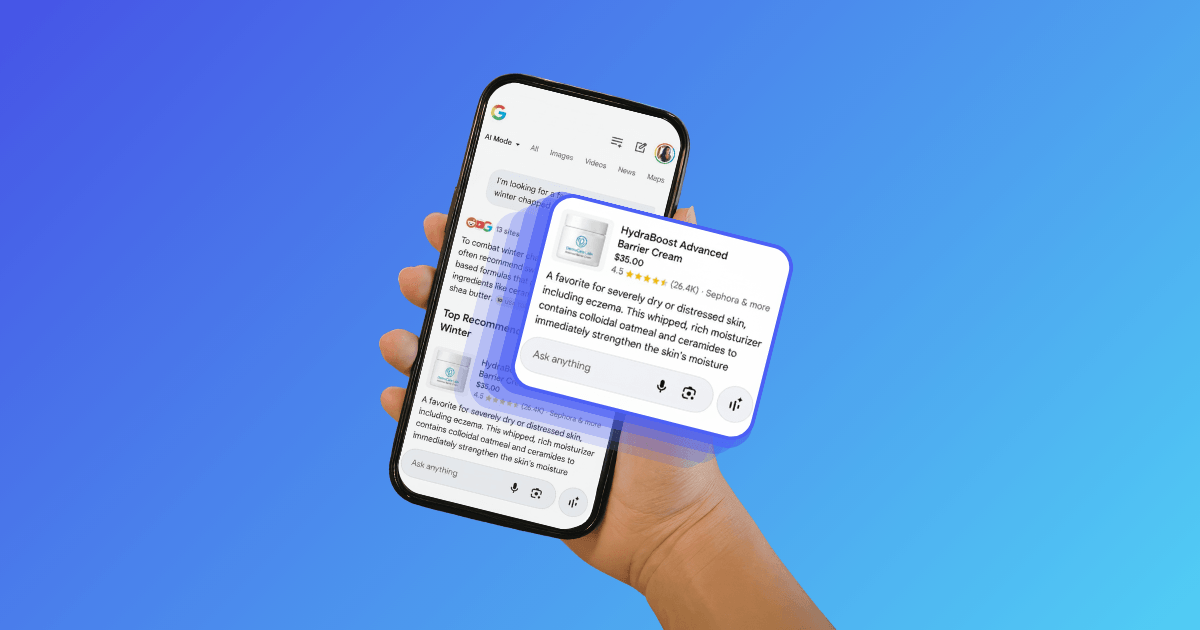
Now think about today. You open Gemini and ask, “I have flat feet and my knees hurt on long runs, what shoe do you recommend?“
You get specific, clear answers with reasons backed by what real customers said.
The internet didn’t just get faster between the 2010s and now, it also got conversational. We started asking questions to AI instead of typing in search terms.
AI traffic to retail sites grew 393% year-over-year in Q1 2026. More than 55% of shoppers actively click on AI recommendations when shopping. While searching and asking feel similar, they deliver completely different results.
Here’s the thing about AI answers: they’re only as good as the information behind them. Search engines like Google regularly scrape data from brand and retail shopping sites. They crawl product pages, reading content, and feeding what they find back into their systems.
Google’s crawlers work through billions of pages on a schedule; they can’t see everything in real-time. Direct syndication of content gives Google richer, structured, and high-definition product data, including customer reviews and photos. The richer and more authentic that data is, the more likely Google is to trust and recommend.
This is why the Bazaarvoice and Google partnership expansion is so important, and why the clients acting on it now are the ones showing up in those answers.
Our 15-year head start on AI shopping
Bazaarvoice and Google have been building together for fifteen years. Over that partnership, Bazaarvoice co-developed the schemas Google uses to ingest product review data.
This means our feed arrives in a format Google’s systems already know how to read, and trust.
That trust now extends further than ever.
The same UGC (user-generated content) you’ve always collected now has greater potential to inform how products are understood, summarized, and recommended across Google’s AI-powered experiences.
Bazaarvoice enables clients to share verified reviews and customer photos in structured formats that Google can ingest and use within its broader commerce ecosystem, including the Google Shopping Graph.
Meet the Shopping Graph: Google’s commerce brain
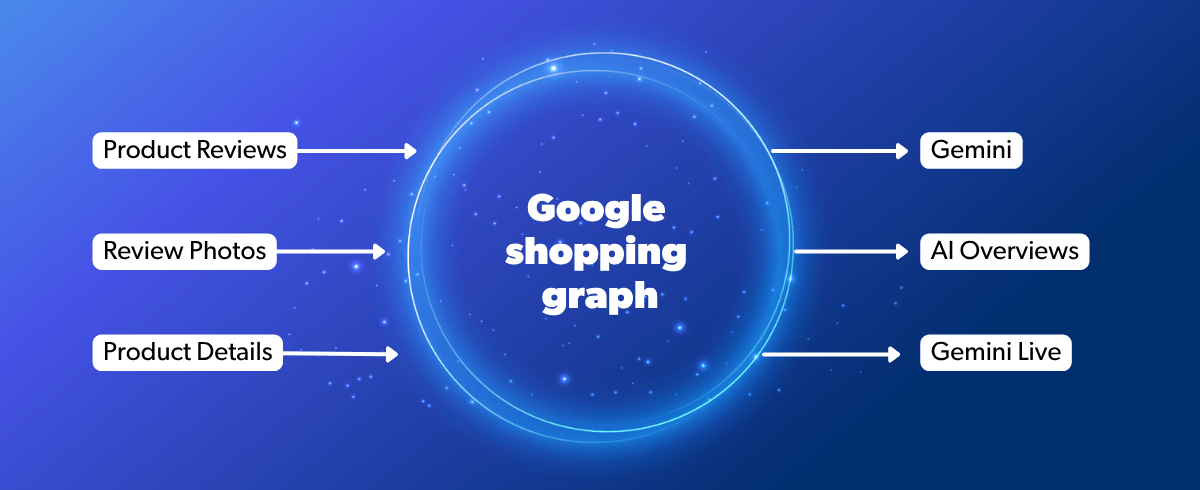
Think of the Google Shopping Graph as Google’s memory for commerce: a database of more than 50 billion products, two billion of which update every hour.
Alongside it sits the Knowledge Graph, which covers the world more broadly: people, places, concepts. When a shopper asks Gemini about the best hiking trails in Patagonia, that’s the Knowledge Graph at work. When the question shifts to which tent to actually pack, the Shopping Graph takes over.
The surfaces (Gemini, AI Overviews, Gemini Live) are where that knowledge gets broadcast.
These systems pull from the Knowledge Graph and the Shopping Graph in real time to make recommendations and field shopper questions. If you want your products to appear in the answers on those surfaces, you need to be present and active in the Graph. That means fresh data, verified details, and enough product depth for the system to work with.
The difference between being crawled and feeding Google directly
Google’s crawlers do impressive work, but they’re designed for breadth, not precision.
A crawler visits your product pages periodically, often weeks apart, and takes what it can find. They’re best-effort by design. What they miss, they can’t surface.
To break it down further, that creates three consistent gaps in AI product discovery:
- Recency gaps: New reviews don’t surface until the next crawl.
- Depth gaps: Nuanced context, including pros, use cases, comparisons, is often missed.
- Interpretation gaps: Misread content can lead to weak or inaccurate signals.
The direct feed solves all three gaps
Bazaarvoice’s direct feed pushes verified, structured review data and customer photos to Google every 24 hours. Explicit data points that Google’s AI can reference with confidence when building recommendations. This means:
- Speed: New, high-converting reviews are pushed to Google every 24 hours, ensuring your most recent customer wins are reflected instantly.
- Accuracy: Structured feeds provide deterministic truth for AI models, minimizing inaccuracies found in surface-level web scrapes.
- Control: Only your verified, moderated content is shared.
This is what structured data for UGC looks like when it’s done right, not just published on the page for crawlers to skim, but delivered with all the important context and details straight to the system doing the recommending.
The human proof behind AI product discovery
Google’s AI won’t recommend a product unless it’s confident. That confidence comes from volume and consistency. It needs multiple verified sources making the same claim.
When a direct feed delivers dozens of reviews all providing the same sentiment about a product, the AI platform has something real to work with. It’s not guessing or filling gaps; it’s drawing on what actual customers said. So when it makes a recommendation, it can explain why, clearly, specifically, in the language shoppers trust.
Without that feed, the AI works from whatever the crawler managed to find. Maybe one or two reviews. Maybe none from the last month.
The result is either no recommendation or one so thin it doesn’t move anyone. A product can be technically present in AI search ecommerce results and still lose out entirely, because the AI couldn’t describe it with enough conviction to convince the shopper.
Yes, verified reviews and customer photos make your product visible in AI search ecommerce. But more than that, they make it describable. That is what converts an AI impression into a purchase decision. The direct feed secures your position in Google’s AI surfaces. Bazaarvoice’s Authentic Discovery™ API extends that visibility across the broader discovery landscape. For Bazaarvoice clients using both, they’re stronger together than either alone.
The technical anchor every generative AI ecommerce strategy needs
Every integration has that one non-negotiable prerequisite. For this one, it’s catalog health.
AI systems depend on clean, structured product data to connect the dots between content and the specific product.
That starts with strong catalog hygiene:
- Consistent product identifiers (like GTINs where available)
- Clean product mappings across systems
- Alignment between your product catalog and platforms like Google Merchant Center
The direct feed enables Google to match your reviews to the right product entity in the Shopping Graph. The data that makes that match possible is typically a GTIN: Global Trade Item Number, a product identifier which comes in many forms including UPC (Universal Product Code), EAN (European Article Number), or ISBN (International Standard Book Number).
If your GTIN coverage is strong and consistent between your Bazaarvoice catalog and your Google Merchant Center, the connection is seamless. If it isn’t, your reviews may not attach to the right products, and the feed’s value doesn’t translate.
Before activation, it’s worth checking your GTIN health against the GS1 GTIN Standards guide. This is the one prerequisite worth checking.
Don’t stay invisible in AI product discovery
Every week, AI models refine their understanding of product categories, prioritizing the most trustworthy sources to satisfy complex shopper queries. Right now category authority is built on data certainty.
A recommendation from Gemini is a signal that you provided the specific context required to meet a shopper’s needs with accuracy and conviction.
Whether you are looking to optimize an existing partnership or are just beginning your AI shopping journey, the objective remains the same: provide the high-fidelity evidence Google needs to make a confident recommendation every time.
How to activate:
If you’re already a Bazaarvoice client, your path to Google syndication depends on your current setup. Reach out to your Account Team to assess where you stand and map out the right next steps for your brand.
If you’re not yet a Bazaarvoice client, the first step is establishing a consistent pipeline of verified, structured UGC that can be distributed across your commerce ecosystem. Get in touch with our team today.
The brands and retailers whose products show up today in AI shopping aren’t waiting to see how it plays out. They’re making their content available to Google’s AI now, while it’s building its understanding of their category. The window is open. Opting in is how you walk through it.