September 29, 2026
If an AI assistant can compare a thousand products in a second, why do 65% of shoppers still click the brand they already know?
That’s the finding from a new Bazaarvoice study based on more than 3,600 shoppers across the US, Europe and Australia. The report revealed that when AI surfaces multiple products, most shoppers don’t select the algorithm’s ‘best match’ on their first click. They choose a familiar name they already trust.
| HOW AI SHOPPERS SELECT PRODUCTS |
|---|
| → 65% Click a brand they already know and trust |
| → 24% Select the product labeled “best match” by AI |
| → 11% Select the lowest-priced option |
That gap tells us a lot. It’s the clearest evidence yet that AI hasn’t replaced brand trust. It’s just changed where that trust has to be earned. Trust still drives the final purchase decision, which you can see firsthand in our latest report ‘What is a brand worth when AI does the shopping?’, conducted in collaboration with independent industry analyst Kiri Masters, publisher of Retail Media Breakfast Club, and one of retail media’s leading voices.
Does AI make brand equity obsolete?
No, AI doesn’t eliminate brand equity. It creates a faster, more demanding environment that tests whether a brand’s reputation is supported by verifiable customer proof.
An AI prompt strips out all of what the traditional retail aisle sold on sight: glossy packaging, eye-level shelf placement paid for by the brand, and a logo recognizable from three feet away. What’s left is whatever information is made available for an AI model to interpret: A list of specifications, a star rating, and a price.
When an AI assistant sits between your product and your customer, does that investment stop paying off?
The data says no. AI hasn’t eliminated brand equity. It’s built a harder, faster test for it. And the brands that understand the strategies that improve brand visibility are the ones who are better placed to navigate that test.
How has brand trust evolved from the shopkeeper to the algorithm?
Brand trust has moved through five broad shifts in validation, and through it all, the shopper has always made the final call themselves.
Every time commerce evolves, the industry predicts the end of traditional brand loyalty. Private labels, online price transparency, and algorithmic search were all supposed to render brand reputation obsolete.
None of those shifts made brand reputation a thing of the past. Shoppers still require someone or something to vouch for quality before making a purchase. The source they trust to provide that proof simply keeps changing.
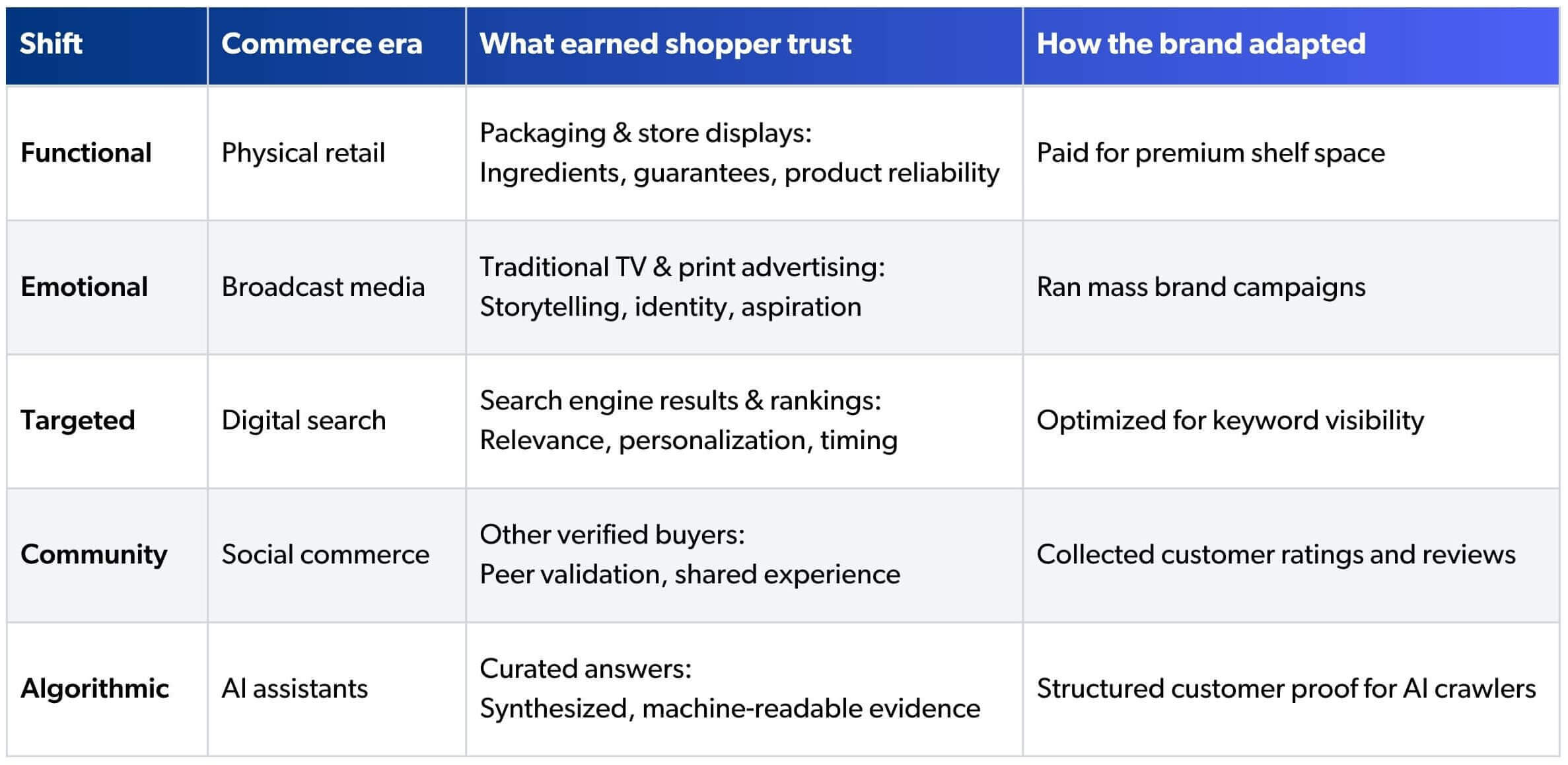
On paper, that can look like the brand losing ground with every era. It’s actually the opposite. The vouching keeps moving further from the brand’s direct control, but the person making the final call hasn’t changed. AI is simply the newest place that final call gets made.
Myth vs reality
1. Does AI shopping create a race to the bottom on price?
The myth: AI tools flatten every purchase decision into a search for the cheapest generic alternative, and brand premiums simply can’t survive an assistant that finds something 30% cheaper in half a second.
The reality: only 4% of shoppers will switch to a lookalike product for a 10% discount. It takes a 50% price cut to move the largest single group of buyers, and 15% will not switch at any price.
That isn’t shoppers being resistant. Loyalty now has a real cost attached to dislodging it. AI makes that cost real and very visible. Research out of Yale and Columbia found the operational mechanism behind this resistance. Deep, structured review profiles reduce perceived buyer risk, which mathematically flattens price sensitivity. This helps protect premium brands from margin pressure even when AI agents surface cheaper generics.
2. Does AI’s best match label override brand loyalty?
The myth: shoppers will simply defer to whatever an AI assistant labels as its top pick, because it’s positioned as the objective, unbiased choice.
The reality: as the numbers at the top of this piece show, 65% click the brand they trust first, more than double the number who take the algorithm’s recommendation.
Only 8% of shoppers say habit or heritage is why they stay loyal to a brand. 45% say it’s because the product performs better. Those two numbers are more connected than they look.
“Shoppers are loyal to brands because they believe they perform better. Few associate their loyalty with habit or heritage. That might objectively be misattributed, but it’s what shoppers believe about themselves. They see themselves as discerning.”
— Kiri Masters, Independent E-Commerce AnalystFamiliarity gets a brand shortlisted before an algorithm’s suggestion is even weighed. But it also means loyalty is a verdict shoppers are actively re-checking, not a status a brand gets to keep once it’s earned.
What makes brand equity provable in AI-driven shopping?
If a shopper’s loyalty rests on believing a product performs better, the job of brand equity in an AI-mediated world is to make that belief easy to verify. Self-descriptive claims and heritage positioning don’t do that work alone anymore, since there’s no packaging or shelf placement for an AI response to lean on.
What remains is proof. Authentic reviews, real usage photos, and detailed written experiences from other buyers. That’s the kind of authentic material that gives both human shoppers and AI discovery engines the richer evidence they need to verify a claim.
It’s also worth being deliberate about where that proof lives. A shopper who gets an AI recommendation will most likely go double-check it on the brand’s own site, on social media, or on a retailer’s product page.
This is where a lot of brands lose out. If the specifications, claims, or review counts don’t match across those environments, the mismatch reads as a red flag, even when nothing is actually wrong. Trust earned in one place needs to travel intact to every other place a shopper might go looking for it.
Why does enduring trust still protect brand equity?
There’s no shortcut to enduring trust. It’s slow to build and fast to lose. But it still puts a brand in a protected category in a shopper’s mind, one an algorithm’s labeled best match can’t easily override.
Brands that treat AI discovery as one more channel to optimize will always be a step behind. The ones ahead are treating authentic, accessible, abundant proof as a structural advantage, because reviews still matter in the age of AI, arguably more than they ever have. Making that proof machine-readable to AI crawlers is the technical layer underneath it all, but the strategic call to build trust is the one brand marketers need to make first.
How ready is your brand for AI-driven commerce?
Protecting brand equity in the AI era is about making sure the trust you’ve built stays visible, provable, and consistent wherever discovery happens. As AI assistants sit between your products and buyers, you would want to look at whether your brand foundation can withstand this shift.
That starts with asking strategic questions: Does your value proposition hold up when packaging and shelf placement vanish? Are performance claims backed by fresh, verifiable customer proof or just brand copy?
Answering these questions requires a clear view of how shoppers evaluate AI recommendations in your specific category.
For a deeper analysis of how brand familiarity, performance-driven loyalty, and category dynamics intersect when AI enters the buyer journey, download the full report: