January 13, 2026
If you’ve been waiting for the moment when AI stops being a novelty and starts handling the credit card, that moment just arrived.
Recently, Google officially ushered in the era of agentic commerce. For the last two decades, brands have optimized for “search”, helping customers find products so they could do the work of buying. Now, brands must optimize for “AI agents”, software that doesn’t just look for products but negotiates, vets, and buys them on the user’s behalf.
Google’s announcement of the Universal Commerce Protocol (UCP), Business Agents, and Direct Offers signals that shopping is moving from search to selection.
But here is the nuance that most tech headlines will miss: An AI agent cannot physically see, touch, or test a product. To make a purchase decision, it relies on two distinct fuel sources: hard data (specs/price) and social signal (reviews/UGC).
Here is what this means for brands:
Part 1: The infrastructure (hard data)
The “plumbing” of e-commerce has changed. Google has moved to an open standard to prevent a fragmented future where we need custom integrations for every bot.
- The Universal Commerce Protocol (UCP): Google has introduced the Universal Commerce Protocol (UCP), a new standard designed to let AI agents “talk” to online stores and execute purchases directly. Think of this as the new “rails” for payments. While this is a major infrastructure shift (one that will likely be solved by your commerce platform or PIM in the coming years), it only solves the final mile: the transaction.
- Business agents (your virtual staff): Google now lets us deploy branded AI agents directly in Search. These act as virtual sales associates. If a customer asks, “Is this compatible with the 2024 model?”, the agent answers instantly.
- Direct offers: This is algorithmic discounting. Brands can now set up offers that only trigger when an AI detects high purchase intent, allowing us to close a sale with a targeted discount at the exact moment of hesitation.
Part 2: The trust engine (social signal)
Before an agent can buy a product via UCP, it has to choose it. We can break the agent’s process down into two phases.
1. Consideration: Winning the search When a user asks for “noise-canceling headphones,” Google’s AI Mode taps into the Google Shopping Graph.
2. Purchase: Winning the selection Once the AI presents options, the user still needs to say “Yes.”
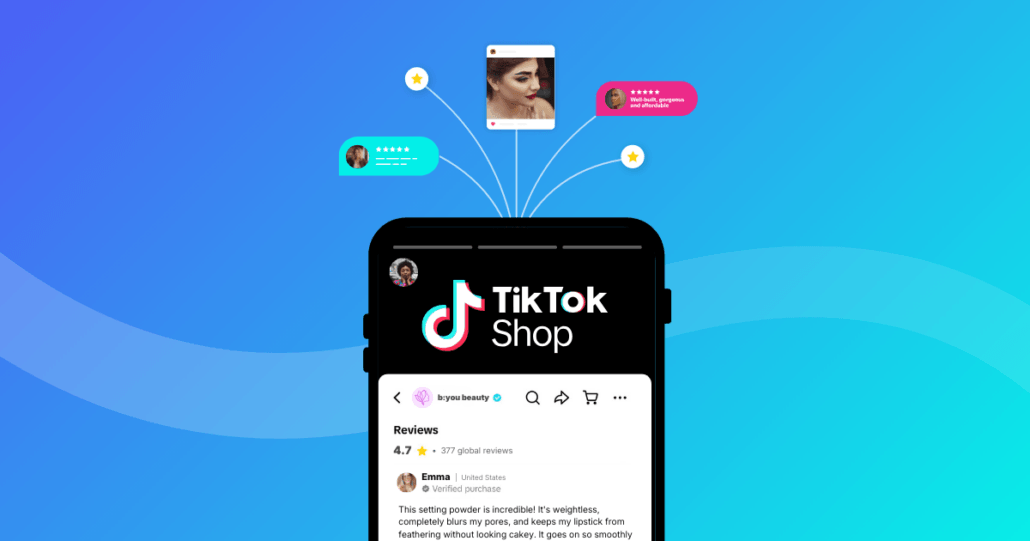
This is where the strategy gets meaty. In an agentic world, Reviews, Q&A, UGC, and creator content are no longer just “social proof”. They are metadata.As highlighted in recent research, when a user says, “Find me a suitcase that fits in a generic overhead bin,” the AI does not look at our dimension charts (which it knows can be inaccurate). It scans thousands of reviews for the phrase “fits perfectly.“
To win in agentic commerce, we must operationalize our community content:
1. Reviews are training data, not just star ratings
A 5-star rating tells an AI nothing. A loaded review that says, “The battery lasted 12 hours on a hike” is gold.
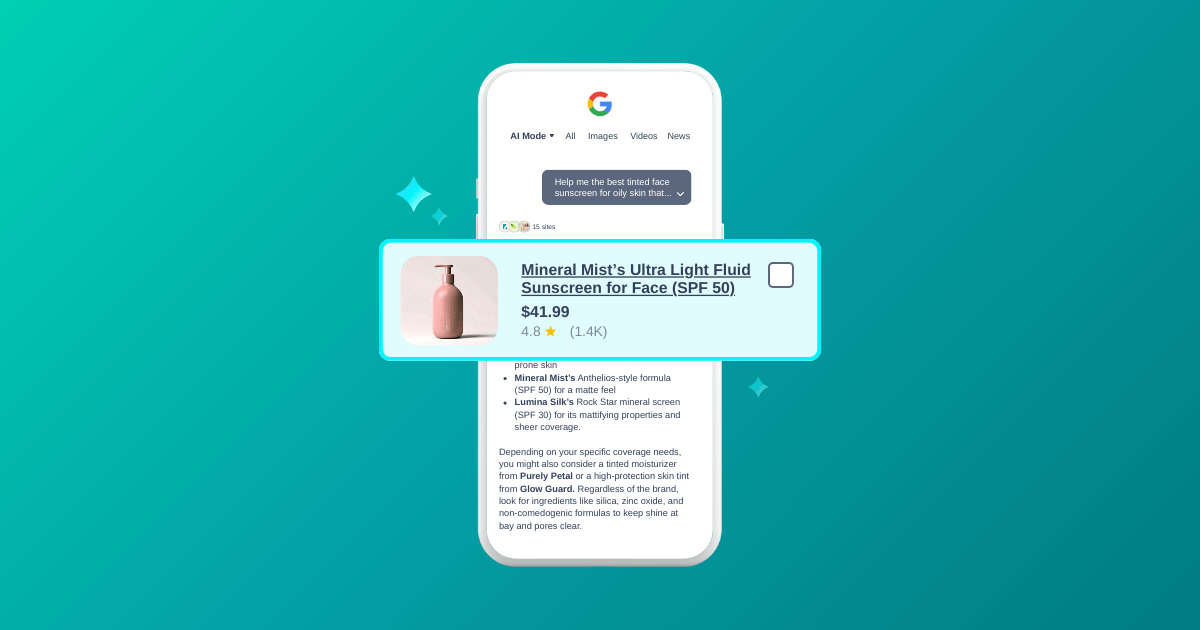
- The shift: Change how you solicit reviews. Move away from “Did you like it?” to prompt for specific attributes (“How was the fit?”, “How was the assembly?”). This creates a semantic layer of data that answers the specific questions AI agents will be asked. Because your customer sentiment, through reviews, becomes part of that graph. The AI uses phrases in your reviews (e.g., “blocks out chatter”) to match your product to the user’s specific intent. Google AI Mode also displays review counts, star ratings, and review verbatims (summaries of what users are saying) next to the product listing. These specific, syndicated details are what give the user the confidence to approve the purchase.
2. UGC as visual verification
With the new business agents, shoppers can ask, “What does this look like on a real person?”
- The shift: Brands must aggressively syndicate user-generated content (UGC) into Merchant Center feeds. Feed the agent photos and videos from real customers so it can provide visual evidence to the shopper. Visual commerce is the evidence layer that prevents “hallucinations” about what a product actually looks like.
3. Creators and Sampling as trust anchors
How does an AI recommend a new product with zero history? It looks for authority figures.
- The shift: Creator partnerships are now essential for “seeding” the algorithm. By getting products into the hands of trusted creators and executing sampling campaignsbefore launch, we generate the third-party validation that the AI scans for. We aren’t just paying for exposure; we are paying to populate the database with positive sentiment analysis.
The agent-ready checklist
To succeed in 2026, we need to treat our data as a product. Here is our immediate action plan:
- Audit data hygiene (the hard data): Ensure our Merchant Center feeds are rich with structured data to win the AI product discovery race.
- Define the brand voice (personality): Brands need to train Business Agents, on the best sales scripts and brand guidelines so it doesn’t sound like a generic robot.
- Incentivize descriptive reviews (soft data): Update post-purchase flows to reward detailed, text-heavy reviews over simple star ratings.
- Rethink the metric: We are entering a world where “site visits” might drop, but “sales” increase. We need to prepare our reporting to measure conversions via agents rather than just traffic to our domain.
The bottom line
The days of hoping a customer navigates our UI are ending. In 2026, the UI is the conversation.
Google has built the tracks (UCP) and the trains (Agents). It is now up to us to ensure we have the cargo, both the technical data and the human trust, ready to load.
Get the AI-ready plan: You know why you need to optimize for agentic commerce. Now get the roadmap for how. We’ve developed the a framework that helps you audit your content strategy to make it accessible, authentic and abundant.
- The Triple-A self-assessment: Diagnose your current standing.
- Content mapping worksheet: Reverse-engineer how AI summarizes your products.
- The action plan: Tactical guides for syndicating the reviews that fuel discovery.
Use the framework to assess your content’s AI-readiness.