May 18, 2026
If Search Engine Optimization (SEO) is about optimizing a product for discoverability, Answer Engine Optimization (AEO) is about defending your brand. There is no coding your way into an AI summary in the age of AEO. With Large Language Models (LLMs) pulling the strings, your brand authority thrives or dies by what the internet and your customers say about you. To optimize your ecommerce site for AI and search, think beyond technical overhauls. Pay attention to the conversations the consumers and your community are already having on product pages.
You could take all the right SEO measures to ensure AI is able to read your website. But you still can’t compel AI to recommend it to discerning customers. Because AI prioritizes narrative and authority over keywords. Your customers are already asking AI for product recommendations. The question is whether AI is finding rich answers on your site or your competitors’. The difference often comes down to something a lot of ecommerce marketers overlook: your product Q&A.
The product Q&A, while often viewed as a simple customer service feature, now serves as one of the primary data sources for LLMs.
Why Q&A matters for AI search engine optimization
Traditional search matched keywords. AI search matches intent. When an AI assistant receives a question, it looks for data that explains how a product works in the real world, who it’s for, and what trade-offs to expect. That shift is what makes AI search engine optimization essential. These models need context, specifics, and real-world use cases. Product Q&A delivers all three.
As shoppers start to rely more on AI assistants during the consideration stage, product pages need to answer real pre-purchase questions with enough context to be useful. When that context is missing, AI is more likely to surface a competitor that gives a clearer, more complete answer. Treat your product Q&A as a core part of AI search optimization.
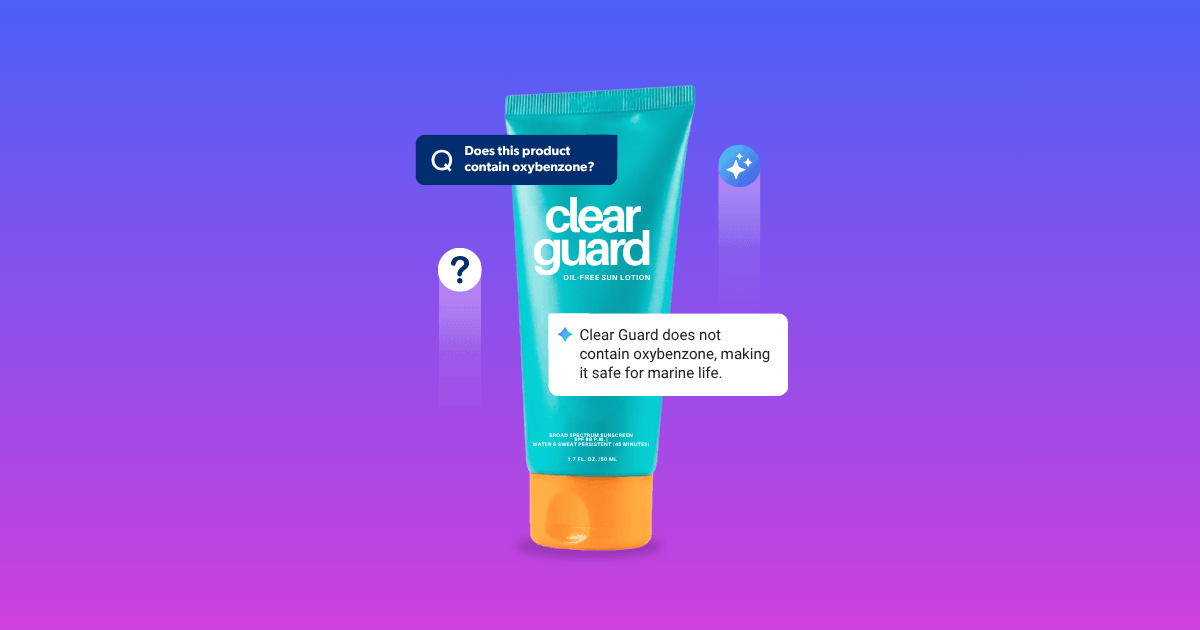
Customer questions give AI models what they need. A shopper might ask an AI agent, “Which mountain bike is best for a beginner who lives in a rainy climate?” If your product page contains a product Q&A section where a real customer asks about rust resistance or tire grip on wet trails, the AI has a direct, citable reference point. These long-tail conversations cover the specifics that standard product descriptions do not include.
The correlation between community answers and AI recommendations
There is academic backing for the community driven approach. A joint study by researchers at Yale and Columbia recently proved that Large Language Models (LLMs) heavily favor and recommend products that possess large volumes of reviews and high ratings. This evidence suggests that the depth of your user-generated content directly influences your “rank” within AI-generated responses. The study measured reviews, but the same principle applies to Q&A: AI models lean towards product listings supported by rich, user-generated content with in-depth reports on customer experience.
Every time a customer answers another shopper’s question, they add a specific, citable data point to your product page. These real-world use cases help AI understand the “why” behind a purchase. If your product Q&A covers specific scenarios, such as “Does this blender fit under a standard kitchen cabinet?” or “Can this fabric withstand a high-heat dryer?”, the AI can confidently recommend your item to a user with those specific constraints. Explore more on why reviews still matter in the age of AI to see the broader impact of user-generated content on your digital visibility.
A step-by-step process for Q&A optimization
To put these best practices into action today, start with a conversational audit of your top product pages.
- Identify common conversational themes. Are shoppers asking about compatibility, durability, or ethics? These are the topics AI will likely be asked about as well.
- Ensure answers are direct and context-rich. A simple “yes” or “no” provides very little data for a machine to process. Encourage your community or your internal experts to provide detailed answers that explain the reasoning.
- Fill the gaps. If you notice specific questions are frequently asked on social media but are missing from your product pages, add them to your site as a pre-emptive FAQ. This makes the information readily available for AI crawlers.
This process ensures that your brand provides a comprehensive map for AI search engines to follow. By treating your product Q&A as a strategic asset, you turn every customer interaction into a search optimization opportunity.
Why conversational context is the primary reference for AI
As shoppers move away from short keywords, AI assistants are becoming the guide of choice during the consideration phase of the funnel. These applications need to answer pre-purchase inquiries in depth and accurately to remain useful to the shopper. If your site lacks conversational context, AI may skip over your brand in favor of a competitor that provides clearer answers.
This is why AI search engine optimization must be a priority for the upcoming quarters. Visibility matters, and so does contextual, structured data. When an AI assistant recommends your product because it found a specific answer in your community content, that recommendation comes with built-in credibility.
What’s a great AI search optimization tool, and do you already have it?
The most effective AI search optimization tool many brands already have is their customer community. When customer questions and answers are managed well and distributed across the web, they help brand content show up more clearly in AI results and recommendations. Fresh Q&A also signals that a product is current, relevant, and actively used, which helps keep the content useful to AI systems.
AI-readability does not require a major site rebuild. It starts with making sure customer Q&A is visible, complete, and easy for AI systems to access. Because verified customer content carries strong authority, detailed questions and answers on product pages give AI a reliable source to use when surfacing responses.
What the future holds
In this conversational revolution, only brands that are easily understood by both humans and machines will be discovered, trusted and chosen. Define the next era of search by establishing your brand as a primary reference point for AI, driving more accurate recommendations and higher conversion rates. If you are looking for a cheat code to appear in AI search results and recommendations, we have just the deep-dive you need.