December 15, 2025
Let’s cut straight to reality: AI is reshaping product discovery. The question isn’t if you need to adapt, but how quickly you can turn your content into the training data AI prioritizes.
Yes, the panic is real. Everyone is looking at their dashboards and asking, “Is my organic search traffic about to collapse? Will AI misrepresent my brand narrative or hand my customers over to a competitor?”
Yes, the ground is shifting and with that comes transformation.
Also yes, search is evolving from a keyword-matching engine into a recommendation and synthesis engine. This transformation has been underway for years, but AI has accelerated it dramatically. But, the brands winning during this transition aren’t the ones panicking.
Brands lose visibility when they are unprepared for how AI learns. They win when they take back control.
Here’s the good news: You don’t need a bigger budget to fix this. You just need to get back to basics and data-driven strategy.
The shift to “Share of Summary” in AI discovery
For decades, succeeding in the e-commerce space meant winning the physical shelf. Then the criteria moved to search rankings. Now we’ve entered the era of “Share of Summary.”
Discovery is becoming democratized. No one can simply buy their way to the top anymore. But that also means only brands with clear, credible, and structured information make the cut. The opportunity lies in understanding exactly what AI systems are looking for, and ensuring your content delivers it.
Demystifying the AI search engine algorithm
AI works on a deceptively simple principle of input and output.
Supply clean data, get smart recommendations. Supply messy data, and the output reflects that messiness. Text in, recommendations out. Structure in, visibility out. Authenticity in, trust out.
This is the new reality of AI search engine optimization. If your catalog data is fragmented, your product detail pages inconsistent, or your product feeds poorly structured, AI can’t learn about your products.
They don’t get ignored because they are bad. They become invisible because AI cannot find you. The perceived “magic” of AI only materializes when it has high-quality raw material. Without it, AI either overlooks you, or fills the gaps in your brand story with information from competitors. Your reputation forms based entirely on what AI reads, verified customer experiences, consistent messaging, credible signals.
But, this shift hands the power back to you. You’re not at the mercy of an inscrutable black box. You’re speaking a language AI already understands. You just need to learn the vocabulary.
The Triple-A framework: Your strategic roadmap
Winning in an AI-driven discovery landscape requires commitment to a structured approach across every layer of your content infrastructure.
This is the Triple-A framework:
Accessible | Authentic | Abundant
Let’s break down each pillar.
Accessible content
For AI to recommend your product, it must first be able to find and understand it.
Accessible content means your product data is clean, centralized, and machine readable across all platforms. This includes structured product metadata, consistent attribute taxonomy, standardized descriptions, and proper schema implementation. Digital shelf optimization is where this becomes operational. Siloed or outdated data doesn’t just hurt user experience, it pushes out your products from showing up on AI-powered search.
Authentic UGC
AI systems trust authentic user-generated content in the same way humans do.
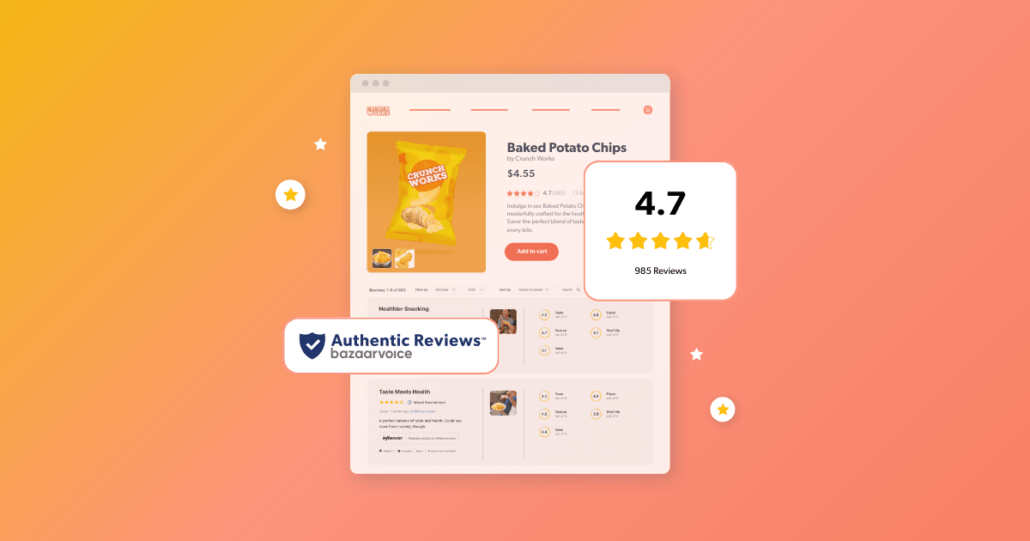
A landmark study from Yale and Columbia revealed what many of us thought, but few quantified: verified reviews and authentic customer feedback are the primary trust signals that generative AI systems use to evaluate, rank, and recommend products. When an AI agent synthesizes information to answer a consumer question, it doesn’t rely on marketing copy. It weighs what real customers have said: their ratings, the specificity of their feedback, the consistency of their messaging across multiple reviews.
The financial reality is, improving your average product rating by just 0.1 points generates conversion lift equivalent to a 67% price reduction. Your review collection strategy can now become your discovery strategy. Quality, verification, and recency aren’t nice-to-have attributes anymore. They’re absolute must-haves in today’s competitive environment.
Abundant signals
Many brands worry, “We aren’t generating content fast enough.” But in the AI era, abundance ≠ volume. A high review count isn’t enough if the data is shallow. AI demands depth of information.
Think about the algorithm’s goal, which is answering specific, complex queries. When a shopper asks, “Are these sneakers stable enough for flat feet?”, a generic 5-star rating offers zero value. AI looks for granular evidence like details on fit, arch support, and usage to verify the answer. It prioritizes products that offer semantic richness and pushes them to the top of summary.
True abundance is about building a content engine that captures the ‘why’ and the ‘how,’ not just the ‘how many.’ Feeding AI the nuanced, varied data makes your product the only definitive answer for the high intent shopper.
The pulse of INSPIRE: What leaders are learning
Across our global Inspire events, a consistent theme emerged from marketing leaders and practitioners: rather than a disaster, the perceived ‘collapse’ in SEO traffic marks the natural maturation of digital discovery.

Brands are no longer gaming keywords to capture empty clicks. Instead, they’re building genuine relevance, authority, and trust, the exact signals that matter in an AI-led world.
One of them captured it perfectly: “It’s not about traffic. It’s about trust and intent.”
The days of chasing high-volume, “empty” traffic are fading. The new mandate is building genuine relevance and authority. Brands achieving this, like Oliver Bonas who saw a 188% conversion lift through visual and social content, demonstrate the payoff of this strategy. The clear takeaway from INSPIRE was that AI isn’t stealing visibility. It’s rewarding clarity. The brands that will win are the ones building a content supply chain that is “sanity-checked” for the AI era.
Your Monday morning action plan
In order to win this, you don’t need a bigger budget. You need focus. Here’s a quick-hit priority checklist to get you started:
- #1. Assess your UGC landscape
Is it verified? Check your current reviews and ratings. How much of your content comes from real, authenticated customer voices? This is a quality-control moment that directly impacts what AI will trust about your brand. - #2. Run a technical audit
Digital shelf optimization relies on clean, centralized data. Is your data machine-readable? Can an AI system immediately understand what you’re selling and why? This is foundational. You can’t optimize for discovery if AI can’t read you. - #3. Shift your mindset
Stop writing only for keywords. Start optimizing for the AI summary. Ask yourself: If an AI were to synthesize information about this product, what key points would it pull? Are we providing those clearly, consistently, and authentically? Are we answering the questions shoppers are actually asking? - #4. Strategize for scale
Begin identifying gaps in your UGC coverage. Which products have rich review depths? Which are thin? Where can you responsibly increase authentic content volume? This is about ensuring AI has real information to work with across your entire catalog.
These best practices for optimizing product listings for AI search are your playbook for 2025 and beyond. Use these to simplify the complex shift to AI-driven discovery into a single, winning formula: feed the machine to win the shopper.
How to futureproof your brand for AI discovery
What separates the winners in an AI-led world? They stopped fearing the black box and started feeding it. They’re engineering the right inputs like high-integrity reviews, structured PDPs, and vibrant customer feedback that AI engines recognize and prioritize.
The Triple-A framework is both methodology and mindset. It isn’t about overhauling strategy overnight, but about disciplined, progressive optimization across every content touchpoint.
The new digital shelf is a meritocracy for those who optimize authentically, abundantly, and accessibly. Your content is the fuel to the AI product discovery engine.
You know why you need to optimize for AI. Now get the roadmap for how. Turn these insights into action with the AI-ready content toolkit. This comprehensive guide provides the practical frameworks you need to audit and optimize your content strategy, including:
- The Triple-A self assessment checklist: Diagnose your brand’s current standing on Accessibility, Authenticity, and Abundance.
- The content mapping worksheet: A step-by-step exercise to reverse-engineer AI recommendations and proactively shape how algorithms summarize your products.
- Your action plan: Tactical guides for collecting and syndicating the authentic reviews that fuel AI discovery.
Lead the shift. Start by auditing your content strategy today.