February 17, 2026
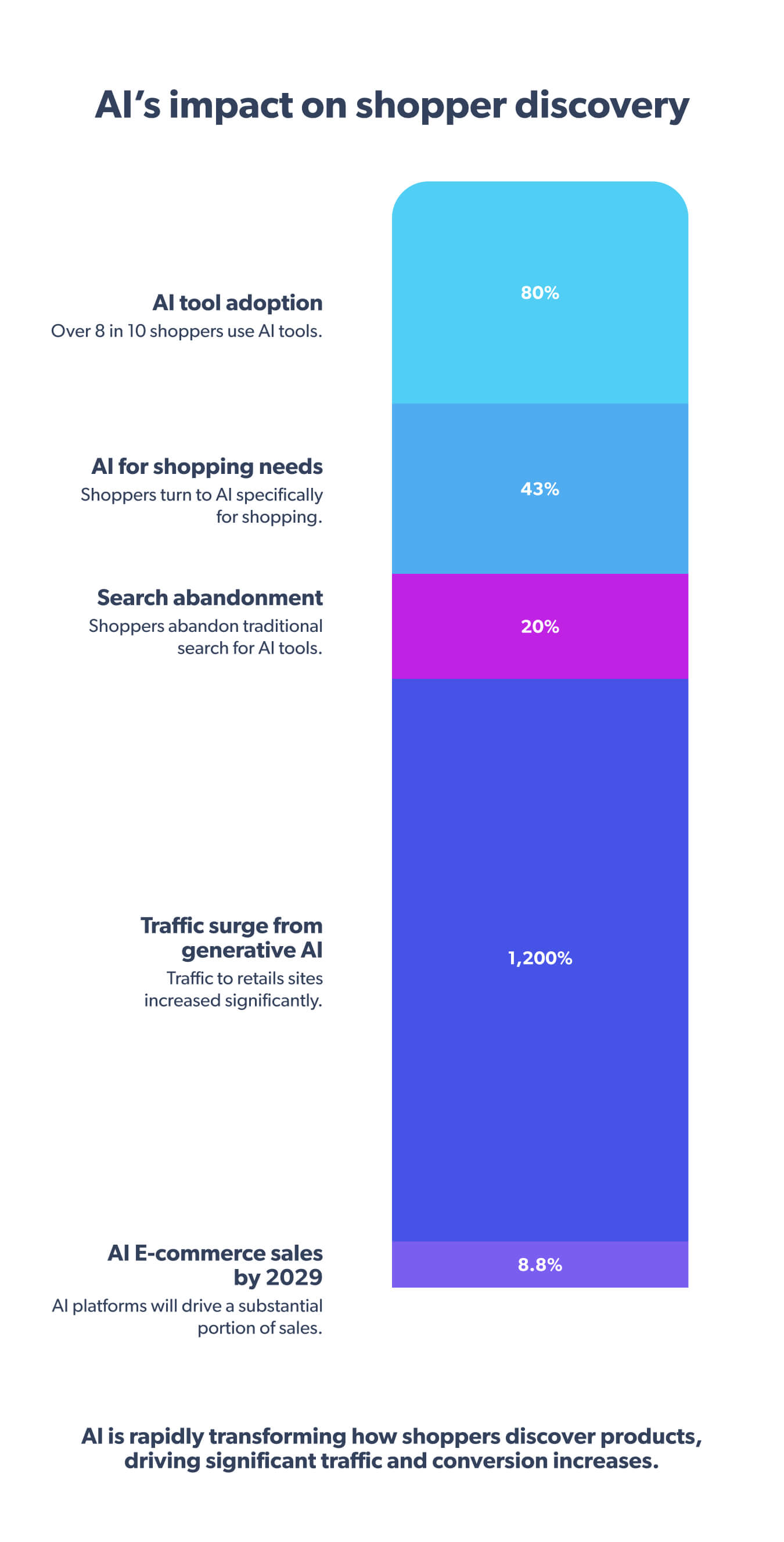
Online shopping is currently undergoing its most significant transformation in over 25 years. And this shift isn’t theoretical; it’s already changing how people find products. Alex Kirk, Director of Insights, Analytics & Measurement at Bazaarvoice, notes that while many use AI to supplement research, nearly 20% of shoppers have abandoned traditional search entirely in favor of AI tools. This represents 1 in 5 consumers who have already moved away from the “browsing” habits of the past.
For decades, the digital shelf functioned through a simple keyword search. You typed a word into a search bar and received a basic list of websites to browse. Over time, this experience became more sophisticated. Search result pages evolved to include paid product ads, rich shop snippets that pulled answers directly onto the screen, and personalized item recommendations. These developments aimed to make browsing faster, yet the fundamental habit remained the same: shoppers had to look through a list of options to find what they needed.
Traditional search is now evolving into generative discovery. In this new environment, shoppers no longer browse through pages of links, videos, images, ads, or snippets to find what they need. Instead, they provide prompts to AI agents that deliver a curated short list of recommendations. These AI systems act as a sophisticated filter; by analyzing a product page’s user-generated content (UGC), the AI identifies key features—like a “foundation for oily skin”—that align specifically with a shopper’s unique needs.
“AI is fundamentally altering the nature of the digital shelf. The winners will be those who recognize this immediately. Soon, AI-guided shopping will be as common as using GPS instead of a paper map”.
Joe Davis, CEO of Bazaarvoice
The real power of these tools lies in the data they ingest. To remain visible, brands must ensure their content is ready for this change. If your products don’t show up where these tools are looking, you lose your seat at the table.
Navigating the shift from search engines to generative discovery
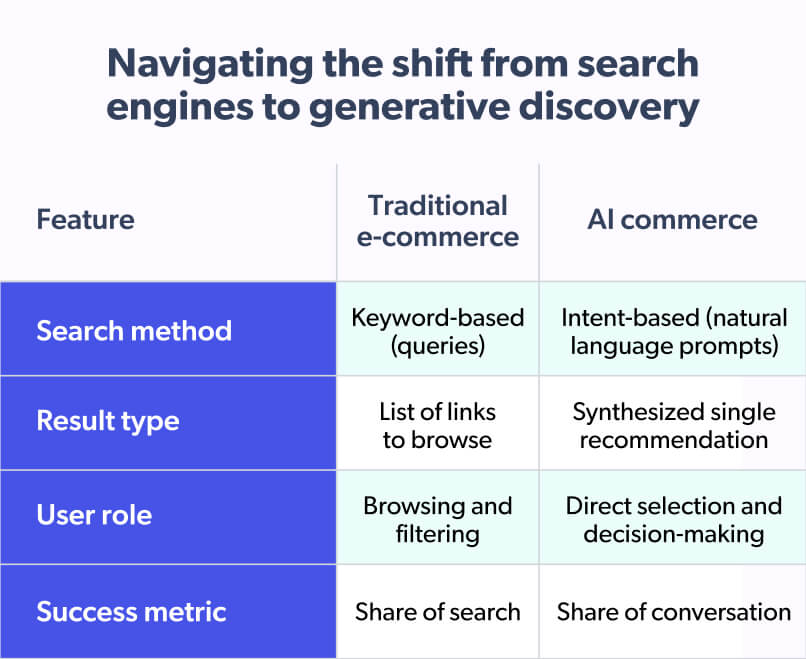
Search is moving from a page of links to a single synthesized answer, often narrowing millions of options down to a handful of tailored recommendations. For years, digital marketing teams focused on winning the share of search. This meant getting your product to appear at the top of a results page for specific keywords.
Neel Arora, Global Head of eCommerce at Nestlé, explains that this focus is changing. We’re entering an era defined by the “share of conversation”. Shoppers now ask AI agents natural questions like “what’s the best moisturizing lipstick for sensitive skin?”. The machine then filters millions of options to provide a curated list of recommendations.
Neel notes that while the digital and physical shelves remain critical, a new point of sale is emerging through AI. He explains, “In the past, we spoke about share of search, but now we are focusing on the share of conversation and how our brands show up”. To participate, you must provide trustworthy content that AI agents can easily find.
“Is your content LLM-friendly? Can it be read by the machine, and therefore is it found? Because if it isn’t, your brand is not going to be mentioned, or worse, it’s going to be a hallucination”.
Neel Arora, Global Head of eCommerce at Nestlé
This transition is known as generative engine optimization or GEO. Traditional search engine optimization or SEO focuses on keywords and backlinks. GEO focuses on establishing your brand as a trusted source for AI engines to cite.
AI agents reward structured intent over keyword hoarding. Machines need information they can easily parse and understand. If your data isn’t structured correctly, your brand may be omitted entirely.
To win today, brands must become visible on three distinct shelves at once. This includes the physical shelf, the traditional digital shelf, and the new AI shelf. Success requires a unified strategy that treats product content as operational infrastructure rather than just a marketing layer.
To win in this new environment, brands must move beyond keyword tracking and adopt what is becoming the new industry standard for digital shelf visibility: The Triple-A Framework.
While AI agents are changing the digital architecture of search, this discovery doesn’t happen in a vacuum; it happens in the palm of the shopper’s hand. AI makes mobile optimization even more critical because the machine’s role is to reduce friction. If an AI agent successfully curates a product based on a complex prompt, but the resulting mobile page is difficult for a human to verify at a glance, the high-velocity “generative discovery” loop is broken.
Why mobile is breaking AI-led conversion
Many brand teams assume their content is accessible simply because it exists online. However, Oliver Bradley, Chief Digital Officer at Neem Consulting, points out a common failure in digital commerce. He calls it the “looks fine to me” attitude.
“Everybody’s still eyeballing it. They say to themselves, ‘If I can read it, that must be fine.’ But this is so ridiculously subjective. Let’s stop and think about this for a second. It literally depends on how good the eyes are of the person designing it and the person approving it. It depends on the screen size it’s approved on and created on. And at no point does it take into account the target shopper’s eyes or device.”
Oliver Bradley, Chief Digital Officer at Neem Consulting
Content for commerce is often created on large 27-inch monitors. Senior leaders then approve this content on 14-inch laptop screens. This process ignores the reality of modern shopping. Today, 76% of U.S. adults use a smartphone to shop or buy online, and in mobile‑first markets like China and South Korea, the vast majority of online shopping happens on mobile devices.
According to Oliver, shoppers on mobile have remarkably small windows of attention. The primary screen is usually under 400 pixels wide. Within that space, your product image has a tiny 90-pixel area to communicate its value.If a shopper can’t determine the size, variant, or ingredient of a product at a glance, conversion rates drop significantly.
Currently, less than 10% of hero images are considered glance-readable. Using all-caps text makes this worse. Caps are up to 20% slower to read and occupy more space. Brands must design for the small screen to survive the evolution from search to generative discovery.
Designing for the small screen ensures your product is visible, but visibility is only the first step. Once a shopper (or an AI agent) finds your page, they need a reason to trust the recommendation. This is where human proof becomes the primary currency of the digital shelf.
Human data as machine fuel
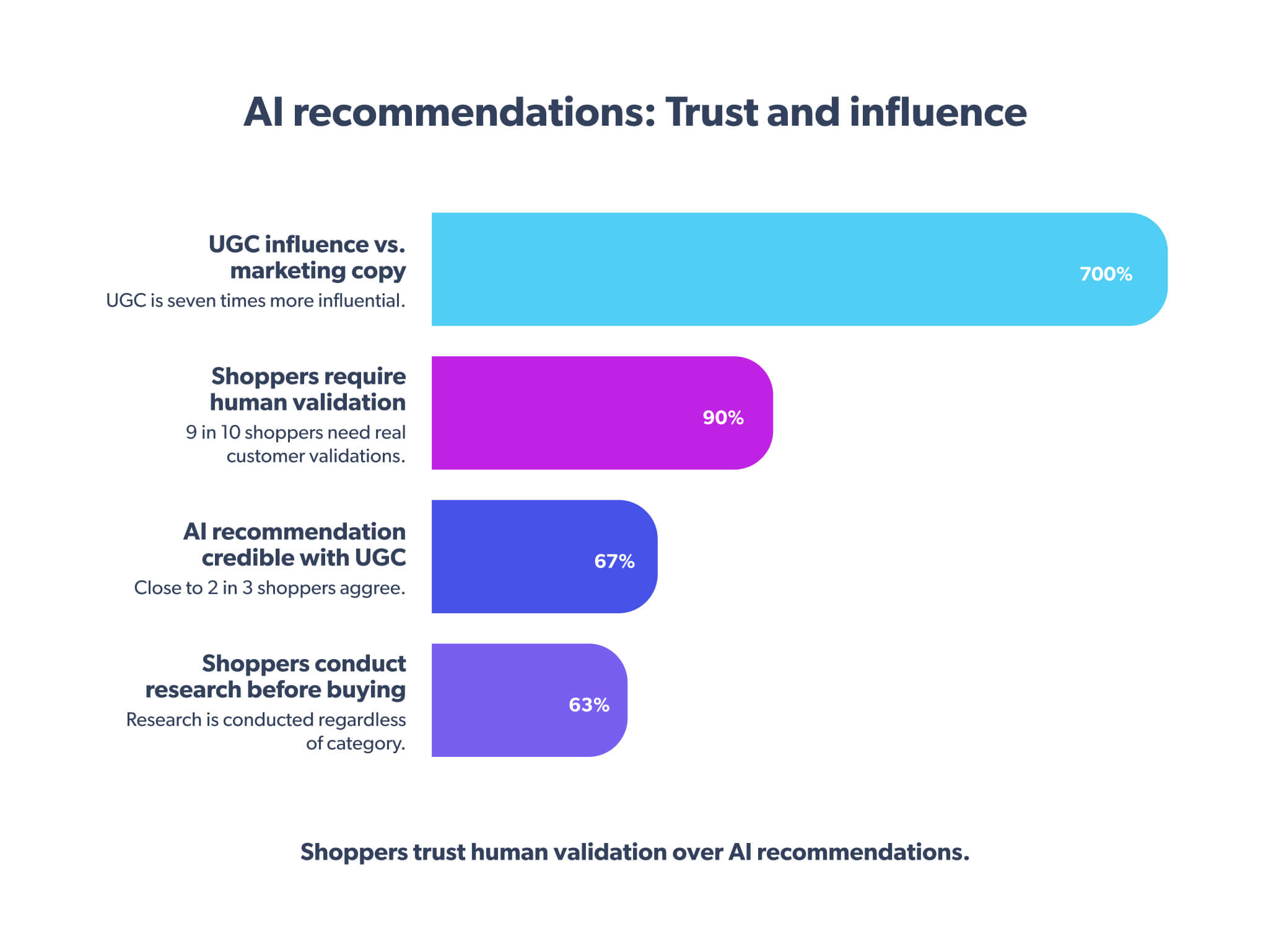
Artificial intelligence agents have become the gatekeepers of consumer intent. To recommend your products, these systems require a constant stream of high-quality data. However, machines do not value all data points equally.Large language models (LLMs) prioritize exactly what human shoppers value: authenticity and verified proof. Research indicates that user-generated content (UGC) from fellow shoppers is up to seven times more influential than brand-provided marketing copy. Authentic reviews and photos provide the specific criteria AI needs to make a confident recommendation to a shopper.
Kiki Croese, Head of Online Shopper Excellence of L’Oréal Luxe, describes this shift as digitalizing the bricks and humanizing the clicks. “In a multisensory category like beauty especially,” she said, “one of our biggest challenges is translating touch, texture, and scent into the digital world, because how do you explain a fragrance note or a cream’s texture through screens?” While a brand can describe a product, only real customer feedback can provide the “in-store feeling” that builds trust at scale.
“AI-driven discovery is changing how shoppers find and trust brands, which raises the stakes on the quality and consistency of our consumer content.”
Kiki Croese, Head of Online Shopper Excellence, L’Oréal Luxe
To remain competitive, brands must treat human proof as a primary data currency. AI models analyze massive datasets of real customer experiences to identify patterns and determine trustworthiness. If a brand fails to provide these authentic signals, it risks starving discovery engines and losing its place in the selection process. As Kiki explained, “UGC gives AI agents the rich, authentic data that is needed to then recommend L’Oreal products confidently.”
Abundant and fresh consumer voices are no longer optional. They’re the essential inputs that allow AI agents to surface your brand when a shopper needs an answer.
But this need for abundant human data comes with a significant catch. In the race to provide machine-ready content, speed cannot outpace safety. Brands must establish clear boundaries to ensure that AI-driven abundance never compromises scientific accuracy or consumer trust.
Guardrails for responsible innovation
Speed is a hallmark of the AI era, but it can create serious risks for brand safety, including misinformation, compliance failures, and erosion of consumer trust.
Charlotte Carter, Head of U.S. Media, Consumer Brands at Galderma, emphasizes that innovation must be balanced with responsibility. This is especially true for brands that deal with sensitive categories like health and wellness.
Galderma operates under pharmaceutical-level standards of care. For their brands like Cetaphil, trust is the primary asset. AI is useful for triaging large volumes of content. However, it can’t replace the human lens required for scientific accuracy.
Some applications of generative AI are strictly off-limits to maintain this trust. For example, Galderma maintains a hard boundary against “fake skin” in their visual assets. They always show real people with real skin conditions like acne.
“So if we’re a skincare brand, we need to be showing real skin on real people and not showing any generative images, because that wouldn’t really be authentic. It wouldn’t be trustworthy. And that’s especially true in general skincare.”
Charlotte Carter, Head of U.S. Media, Consumer Brands at Galderma
Using AI to swap a background color is acceptable for efficiency. But using it to simulate product results is deceptive and erodes long-term credibility. Authentic storytelling from real consumers who have had a genuine “acne journey” remains irreplaceable.
Establishing these guardrails is essential, but most organizations struggle to enforce them because their content is too fragmented. To scale authentic content without losing control, we must stop treating content as a creative add-on and start treating it as a functional supply chain.
The content supply chain bottleneck
The concept of a content supply chain parallels a traditional product supply chain. It involves forecasting demand, manufacturing content assets, and then warehousing and distributing those assets to the correct outlets. Finally, brands must analyze the resulting data to improve the next forecast.
To move from a fragmented model to a unified one, brands must establish a central “source of truth”—a single repository where product data, media, and human proof live together. This unification allows teams to move away from manual hand-offs and toward an automated flow that ensures every discovery engine receives the same high-quality data.
“Fragmented content kills shelf visibility and functions as a strategic liability. Reviews in one place, content in another place, product details owned somewhere else, media assets in a totally different system yet again. When content types are trapped in these silos, brands effectively have zero visibility where it counts most.”
Doug Straton, Chief Marketing Officer at Bazaarvoice
This fragmentation results in zero visibility where it matters most. Performance on the digital shelf requires high velocity. Moving content quickly helps build trust at the moment a shopper is ready to choose.
Data governance serves as the primary differentiator for modern brands, as Straton explains: “Clean data architecture isn’t back-office work. It’s the engine that converts these signals into revenue. And that is a competitive differentiator if you don’t know where to start as it relates to overall capabilities that you already have and how to stitch them together.”
Gregor Murray, Chief ‘So What’ Officer at Digital Commerce Global, points out that content frequently gets stuck in handoffs between teams.
Operationally, a unified content supply chain provides a clear “so what” for every functional area of the business:
- Marketing teams: Can move from technical “keyword hoarding” and technical SEO hacking toward deep contextual relevance that answers natural-language shopper questions.
- Supply chain & ops: Can align content manufacturing directly with product forecasting and launch schedules, ensuring that “gold standard” content is visible from day one of a new product launch.
- Customer experience (CX): Can utilize AI Q&A agents integrated with onsite shopping assistants to surface relevant reviews and answers, removing purchase friction at scale without lengthy data reviews.
To identify these bottlenecks, experts utilize the SEEC framework. SEEC stands for Strategy, Enablers, Execution, and Culture. It is a structured audit that compares a manufacturer to its peers and competitors to find gaps in digital maturity.
This framework helps brands pinpoint “red zones” like poor governance or search performance. By using the SEEK model, brands can identify what to fix first to deliver the most sustainable results. Experts recommend fixing these basic operational processes before pursuing complex innovation.
Fixing these internal bottlenecks does more than just optimize your website; it creates a ripple effect across the entire business. When you master your content supply chain, you unlock a powerful omnichannel advantage known as the ROBO effect.
The omnichannel “halo” effect
The impact of high-quality product content reaches far beyond the digital checkout button. Kiki Croese of L’Oréal Luxe highlights that DTC websites influence the entire retail ecosystem. This is measured through the ROBO (research online, buy offline) effect, a phenomenon where digital confidence drives physical world revenue.
Data from Bazaarvoice shows that 27% of shoppers in the health and beauty category read online reviews while standing in a physical store. L’Oréal’s internal benchmarks demonstrate the financial weight of this behavior: for every 1 Euro spent online that is influenced by reviews, an additional 3 Euros are spent in a physical store.
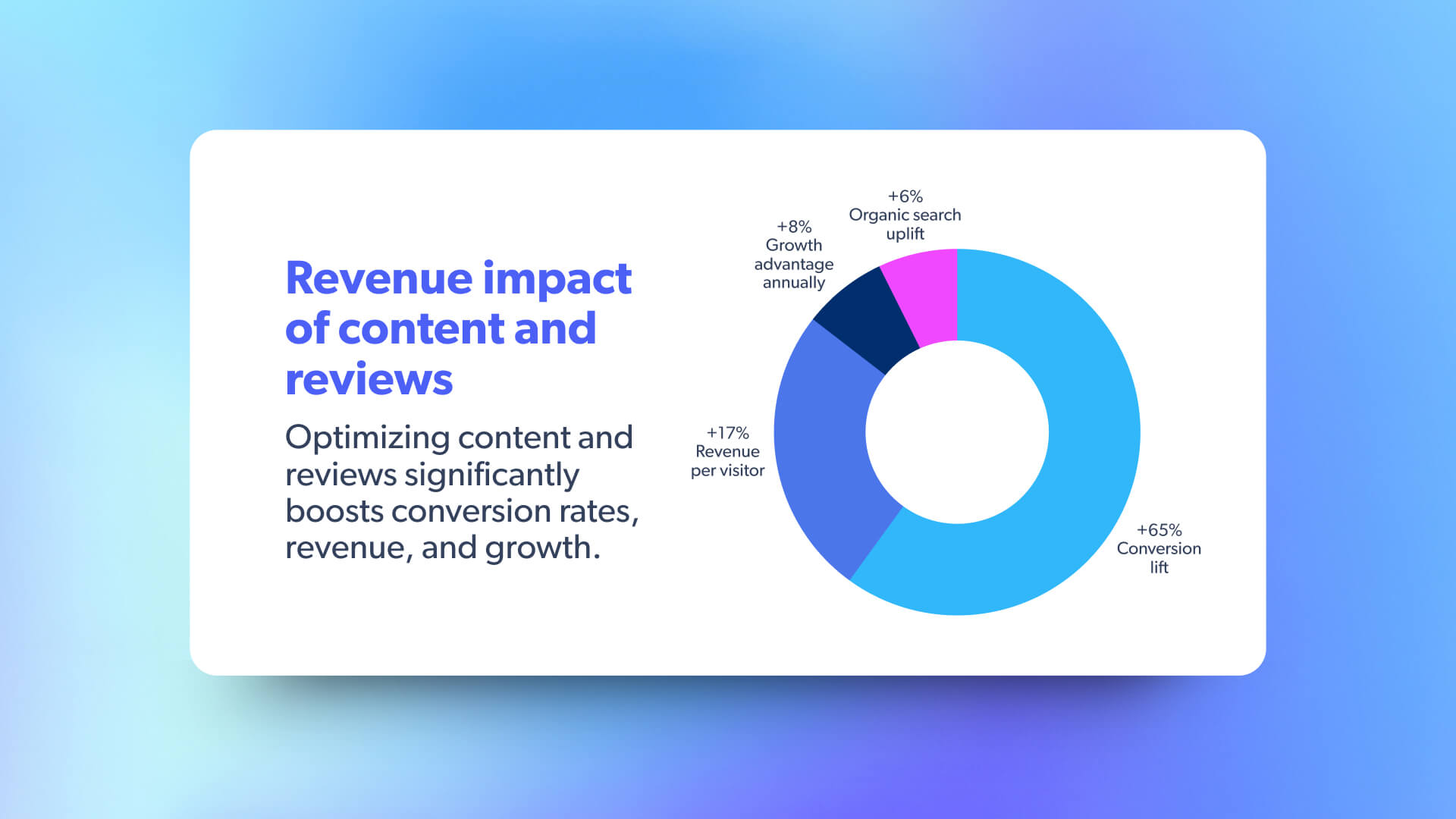
This 3x ROBO multiplier proves that the digital shelf is not a siloed e-commerce asset; it is a core driver of total omnichannel revenue. By ensuring that ratings and reviews are placed “above the fold” on a mobile page, brands can foster immediate engagement that captures this spillover revenue. For L’Oréal Luxe, visitors who engaged with reviews saw a 65% higher conversion rate and a 17% increase in revenue per visitor.
To consistently capture this omnichannel revenue, brands need a repeatable quality bar. This is the logic behind the Triple-A framework—a three-pillar standard designed to make your products selected by machines and trusted by people.
The new standard for the digital shelf
Success in generative discovery requires a new set of standards for product content. That’s why brands need to adapt the Triple-A framework to ensure they remain visible and trusted by both humans and machines. This framework consists of three pillars: accessibility, authenticity, and abundance.
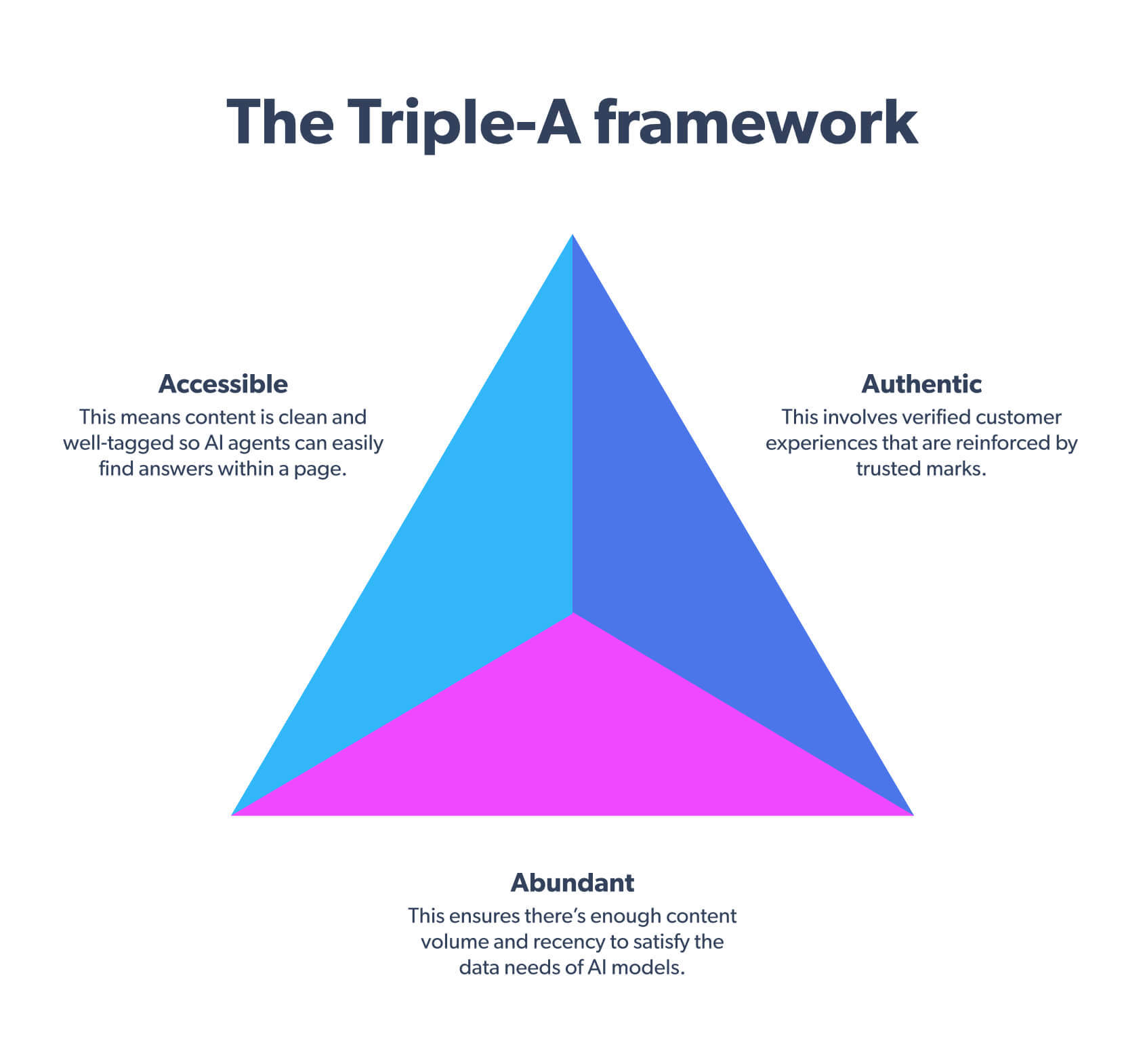
These three pillars are now the prerequisites for being surfaced in AI recommendations. Large language models search through actual product experiences to answer detailed shopper questions. If a product only has generic marketing copy, the machine may not be able to answer accurately. This could result in your brand being excluded from the final recommendation.
Sarah-Jayne Tunstall, Digital Brand Campaign Manager at Pladis—the global snacking giant behind well-known brands like McVitie’s, Jacob’s, and Carr’s—explains that building this foundation requires simple and scalable wins. Her team moved from ambiguity to measurable benchmarks. “We have the number of reviews, so we like to check that there is a baseline of 40 reviews per SKU and a minimum of four stars,” she explained. They also focus on recency to ensure reviews are less than six months old.
AI platforms can only answer complex shopper questions when they have enough detailed data to process. By adopting the Triple-A standard, brands move from being one of many options to being the definitive answer provided by AI.
How to build AI-ready commerce experiences
To meet the abundance and accessibility demanded by the Large Language Models, brands are starting to treat shopper content as infrastructure, not an add-on.
That shift is showing up in three ways:
1. Make trust signals machine-readable
AI agents can’t rely on what they can’t interpret consistently. Brands are moving toward cleaner, more structured ways to surface trust signals like ratings, reviews, and Q&A so they’re easier for discovery systems to recognize and less likely to be misread or misrepresented.This is the practical side of accessible: reduce ambiguity, increase clarity, and keep product truth stable across the places shoppers (and machines) learn from.
2. Convert discovery into confident selection
Being discoverable doesn’t automatically lead to sales. The more AI compresses browsing into shortlists, the more brands need experiences that help shoppers validate product fit quickly.
The patterns emerging here are shopper-first, not gimmicky:
- Summaries that reduce effort when there’s a high volume of feedback
- Richer connections between social proof and product detail pages
- Faster paths from inspiration to checkout
This supports “authentic” and “abundant”: the goal is not to replace the human voice, but to make it easier to consume and harder to dismiss.
3. Sustain abundance without burning out the customer
More brands are experimenting with value exchanges that encourage customers to share their experiences without turning the digital shelf into a wall of generic noise. The intent is to increase participation while protecting quality through smarter timing and clearer guidance. This is where “abundant” becomes a strategic goal: the focus is not on more words, but on more high-value data signals.
To achieve this, leading brands utilize a “content coach” or AI-powered review guidance. Instead of presenting a blank text box, these systems provide reviewers with specific prompts based on the product category. For example:
- Apparel brands prompt for “fit” and “durability”.
- Food and beverage brands ask about “taste” and “texture”.
- Consumer tech brands encourage discussion on “battery life” and “ease of use”.
By guiding the shopper to discuss these specific attributes, brands ensure the resulting content is rich with the natural-language keywords AI agents need to match products with complex consumer prompts. This structured guidance helps sustain a high volume of “fresh” content—ideally less than six months old—without exhausting the customer with lengthy, unguided submission forms.
The future of human connection
The transition to agentic commerce doesn’t signal the end of human relevance. Instead, human connection is poised to increase in value as brands compete for authenticity in a machine-driven world.
AI is best viewed as an Ironman suit: a tool that allows practitioners to work with more velocity and precision, but one that still requires a human pilot.
While your marketing teams must now ensure products are accessible to bots, the final purchase decision still belongs to a human being. Shoppers are becoming more discerning as they interact with AI agents. They’re increasingly likely to ignore polished marketing copy in favor of real, unfiltered experiences shared by their peers. AI tools help shoppers filter through the noise of the digital shelf, but human proof provides the emotional confidence required to complete a sale.
Success in this era requires a balance between rapid technological innovation and responsible leadership. Leaders should avoid chasing theatrical AI applications—or “AI theater”—before their foundational content supply chain is stable. A disciplined approach to data governance and authentic content collection remains the most durable safeguard for any brand.
By fixing your operational foundations today, you ensure your products remain both visible to machines and trusted by people in the intelligent marketplaces of tomorrow.
Take control of the AI shelf
The rules of the digital shelf have been rewritten. We are moving past the era of manual browsing and into a high-velocity environment where AI agents act as the ultimate gatekeepers. In this new reality, “good enough” content is no longer an option. If your products are not accessible to the machine, authentic to the shopper, and abundant enough to satisfy the algorithm, your brand will simply cease to exist in the conversation.
The transition from “share of search” to “share of conversation” is happening now. The brands that thrive will be those that stop treating content as a back-office task and start treating it as the critical operational infrastructure it is. You have a choice: master the new standards of generative discovery today, or watch your competitors become the only recommended choice tomorrow.Don’t let your brand become invisible. Download the Triple-A framework playbook.
Frequently asked questions about AI commerce
How does AI commerce work?
It operates on a feedback loop of inputs (product data and human reviews) and outputs (AI-synthesized decisions). Machines act as decision agents that filter products based on a brand’s “share of summary” and content structure.
How can brands prepare for the shift toward generative discovery?
To prepare for the shift toward generative discovery, brands must satisfy the Triple-A framework to remain visible to machines and trusted by people. This involves ensuring content is accessible through clean, well-tagged data that AI agents can easily parse, while maintaining authenticity by powering the digital shelf with verified customer experiences. Finally, brands must achieve abundance by providing the data volume and recency required for LLMs to make confident recommendations.Download the toolkit to audit your UGC reach and build a plan to strengthen the content AI systems can access, trust, and summarize.
What is the difference between “share of search” and “share of summary”?
Share of search measures your visibility in a traditional list; it’s about how often your brand appears when a shopper types in a specific keyword. Share of conversation measures your authority in a dialogue. It tracks how often an AI agent specifically identifies, cites, and recommends your brand as the best solution when answering a shopper’s natural language question. While the share of search is about being seen, the share of conversation is about being chosen.
What is generative engine optimization (GEO)?
GEO is the process of optimizing your product content specifically for LLMs like ChatGPT, Gemini, and Perplexity. It focuses on providing structured, authentic data that AI agents can easily parse and use to answer consumer prompts.
How do AI agents use customer reviews?
AI agents “scrape” and analyze massive datasets of real user experiences to identify patterns and determine product worthiness. Reviews are the most heavily weighted data points AI uses when making a recommendation.
What is the ROBO effect in e-commerce?
ROBO stands for “research online, buy offline.” It describes the consumer behavior where digital content—like reviews and ratings—influences a purchase that eventually happens in a physical retail store.
How many reviews does a product need to be AI-ready?
A product must have a minimum of 30 approved reviews across supported languages (English, French, German, or Spanish) to generate an AI-powered review summary. This baseline allows the system to accurately consolidate customer feedback into a concise overview that identifies common product features, strengths, and weaknesses.
What happens if my product data is not structured for AI?
If your content is not LLM-friendly, your brand may be omitted from recommendations entirely. In some cases, a lack of clear data may cause the AI to “hallucinate” or invent incorrect details about your product, which can erode consumer trust.