January 30, 2026
The job of the modern e-commerce manager just got a lot more specific.
It used to be about fighting for a spot on page one of Google; today, it’s about making sure your brand is included in the small, curated set of recommendations AI provides shoppers.
As consumers shift their product research to AI agents, including ChatGPT, Gemini, and Perplexity, the traditional SEO playbook alone is no longer enough. We are in the era of generative engine optimization (GEO). In this new landscape, you don’t just want to be found; you want to be recommended.
New exclusive research from Bazaarvoice and EMARKETER, spanning over 5,600 shoppers, confirms that AI is the new gatekeeper of the digital shelf.
The 2026 reality check: Your TL;DR
Shoppers are no longer typing fragmented keywords; they’re expressing their intent.
- What changed: A whopping 83% of shoppers have used AI (generative tools, personalized recommendations, voice assistants) in the last six months. They turn to these tools for various needs: 43% use it for shopping, while 44% use it for product comparisons.
- What hasn’t changed: Trust remains the primary currency. AI makes discovery easy for consumers, but the burden of proof remains on the brand. Shoppers still want the best possible value without sacrificing quality, and they are embracing AI to objectively compare reviews and specs.
- What to do next: Follow our Triple-A framework. First, make your data accessible so it is clean, portable, and easy for AI to find. Second, stay authentic by using verified reviews as your primary signal. Finally, build abundant depth with text and media to answer specific shopper questions.
The key stat: While 54% of shoppers use AI as a research supplement, 18% have already replaced traditional search with generative AI tools.
| About the research: Two major global surveys conducted in collaboration between Bazaarvoice and EMARKETER in late 2025, polling over 5,600 unique shoppers across North America, EMEA, and APAC. |
AI: The new gatekeeper of the digital shelf
While some see AI as a barrier, the data suggests it’s actually the most sophisticated discovery engine we’ve ever seen.
Shoppers are facing choice paralysis. Rather than wading through a world of options, they turn to AI to cut through the noise and deliver a select shortlist of products that align perfectly with their unique, niche requirements.
To do this, AI doesn’t just look at product descriptions; it mines user-generated content (UGC). It scans reviews and testimonials to find human verification that a product actually does what the shopper needs it to do.
So, how do you turn AI into your biggest advocate and ensure your brand is surfaced accurately and often?
The power of clarity and context
The stakes are incredibly high: 42% of shoppers have opted not to purchase a product specifically because of a poor or vague AI answer.
Consider a shopper looking for a face wash. They aren’t asking for “a good cleanser”. They are asking for a “gentle cleanser that works for rosacea and doesn’t leave a tight feeling”.
- Without AI: The shopper reads dozens of labels and hopes for the best.
- With AI: The engine scans thousands of reviews to identify specific customer phrases like “helped my redness” or “skin felt hydrated, not tight.”
When your reviews contain those specific validation points, AI moves your product from the generic pile to the “highly recommended” shortlist.
If AI can’t find specific UGC validation that matches the shopper’s niche request, it won’t gamble on your brand. It prioritizes precision over variety. You haven’t necessarily been “rejected” by the consumer; you simply weren’t surfaced because the engine couldn’t find the specific review data to prove you were the perfect match.
You can prevent this by ensuring your product data is explicit and your UGC is verified. This way, AI doesn’t have to generalize; it can see exactly how real people use your products.
| Traditional SEO (hype) | The GEO reality (inputs) |
| Focus on ranking for keywords | Focus on winning the “share of summary” |
| Keyword density for crawlers | Data density for LLMs |
| Broad reach to drive clicks | Clarity and human proof to build shopper confidence |
By feeding the AI a high volume of human intent signals, like detailed reviews and customer photos, you ensure the engine has enough context to match your products to the right shopper conversations.
The more context you provide, the easier it is for an AI agent to recommend your brand.
Why “being found” is no longer enough
Discovery is only half the battle. Our second wave of research reveals a significant “trust gap.”
Shoppers outsource the research phase to AI. They trust it to do the legwork of comparing prices, finding product info, and even providing recommendations.
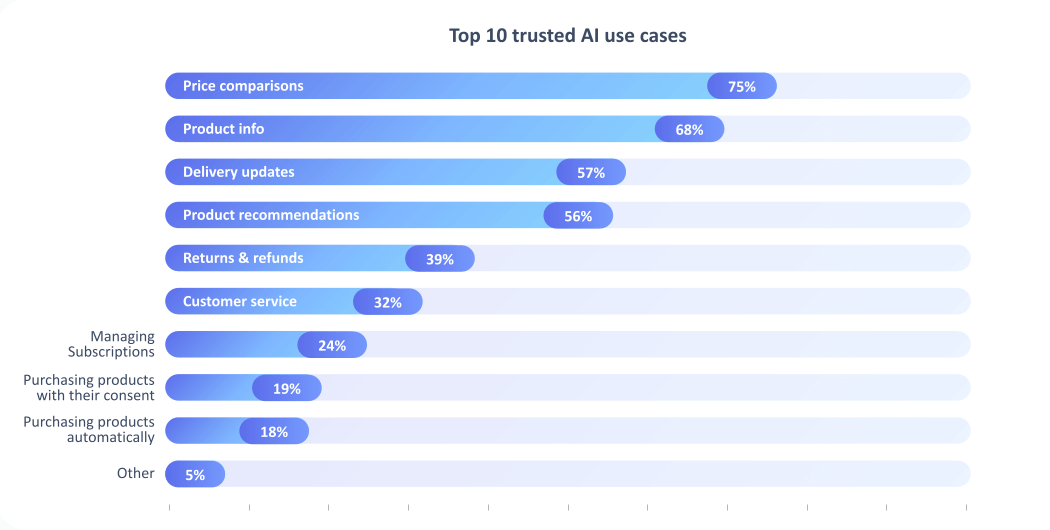
However, confidence drops sharply when the stakes get higher. Only 19% trust AI to make a purchase for them. The bot can find the product, but it can’t yet close the deal on its own.
And here’s the kicker: Shoppers do not trust AI summaries blindly; they trust the human voices powering them.
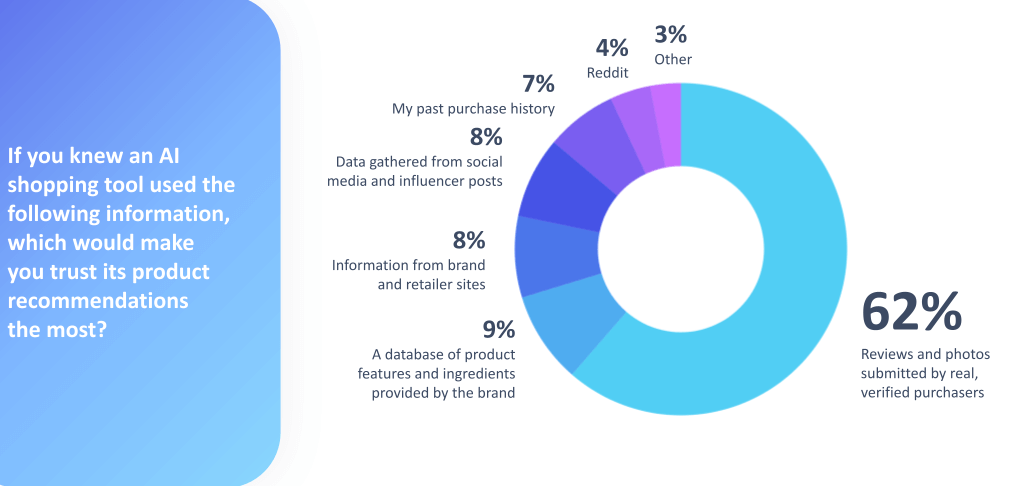
When asked what would make them trust AI recommendations, 62% of shoppers chose reviews and photos from real, verified purchasers. This is 7 times more influential than brand-provided information (9%).
We know one thing for sure: human content is the anchor of AI confidence.
“Shoppers feel better knowing that real customer content is what is feeding the AI’s recommendation,” explains Alex Kirk, Director of Insights, Analytics & Measurement at Bazaarvoice. “But it doesn’t stop there — they will still go to the product page to read more reviews and verify that choice for themselves before they buy.”
By ensuring your UGC is authentic and accessible, AI agents can cite your customers’ voices as the definitive proof for their recommendations.
The brand site: Your destination for trust
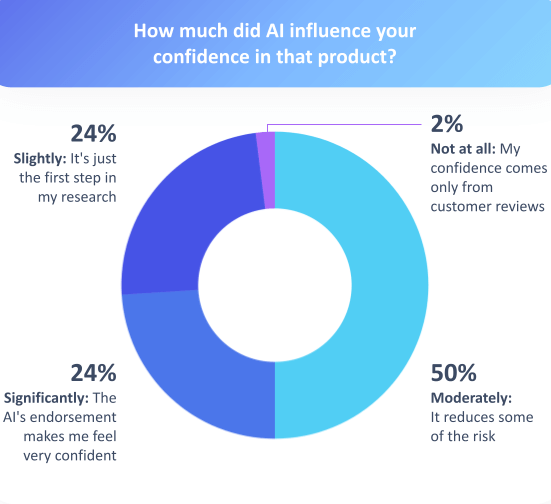
While AI influences confidence for 74% of shoppers, it is rarely the sole driver of the final sale. For a quarter of them, AI is just the first step in the research phase.
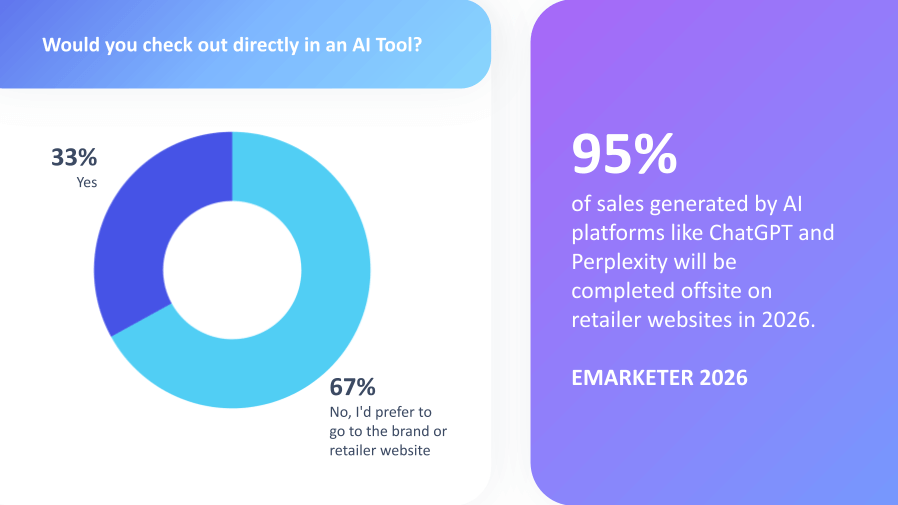
The “trust handoff” remains vital. About 2 in 3 shoppers prefer to leave the AI tool to complete their purchase on a brand or retailer’s website. In fact, EMARKETER forecasts that 95% of AI-influenced sales will still be completed offsite in 2026.
Carina Lamb, Senior Analyst, Retail & Ecommerce, EMARKETER, notes: “Brands and retailers still need to focus on optimizing product pages for conversion, and making sure handoffs from AI platforms to their own sites are seamless and friction-free”.
Your product detail page (PDP) is not just a landing page; it is the destination for validation.
Shoppers are now used to having helpful conversations with AI, but most brand websites are still stuck in the era of rigid keyword searches. When a user moves from a conversational AI chat to a clunky, keyword-based site, they often get frustrated and leave.
You can fix this disconnect by making your own site feel more like an assistant. By allowing natural language searches and using AI to summarize reviews on your product pages, you give shoppers the seamless experience they have come to expect everywhere else.
Securing the future of zero-click commerce
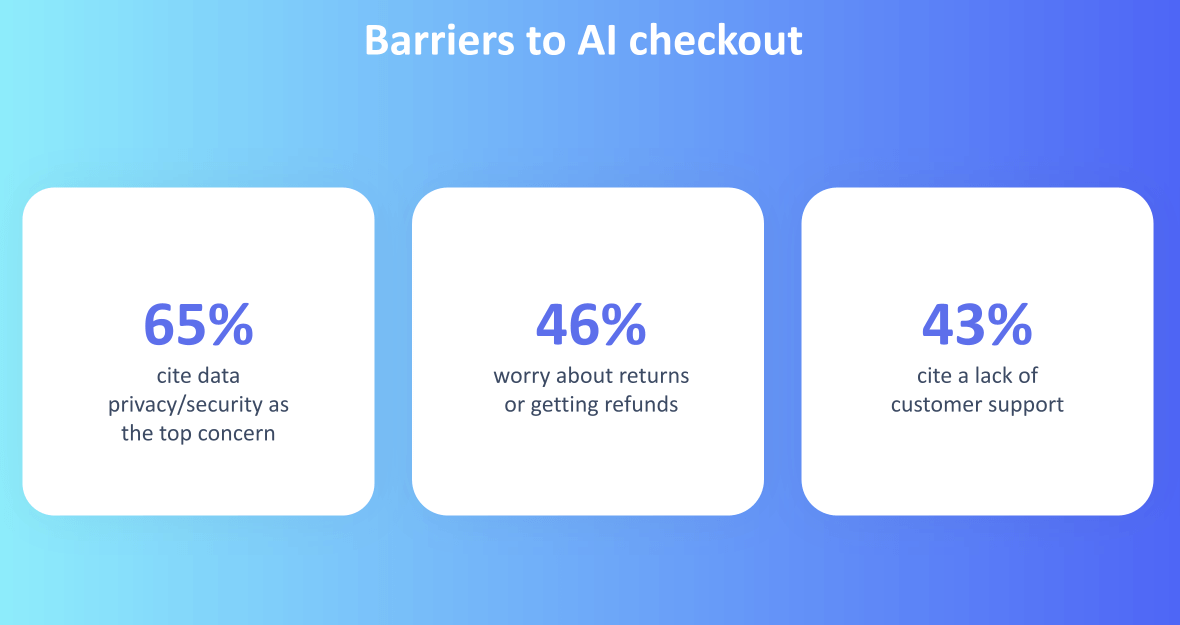
Why aren’t shoppers buying in-tool? It comes down to anxiety.
Our research shows that 65% of consumers are held back by data privacy concerns, while 46% worry about returns or refunds. These are the same old trust issues that slowed down social commerce in its early days.
Carina explains: “Rather than replacing shopping journeys, AI platforms are going to be another channel that brands and retailers can leverage — in a similar way to how they are leveraging social platforms like TikTok today”.
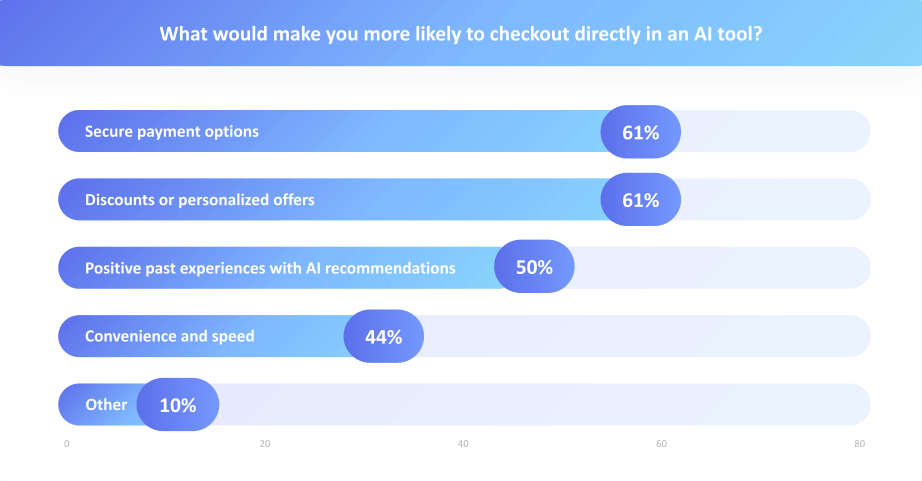
While security is currently the biggest barrier, it’s also your primary bridge. About 61% of shoppers say secure payment options would convince them to use AI checkout. The industry is already moving to solve this through major partnerships, such as OpenAI and Stripe’s Agentic Commerce Protocol and Google’s new Agent Payments Protocol (AP2).
Beyond technical security, you can drive conversion by taking a page from the social commerce playbook: offering specific discounts or personalized deals directly within the AI interface.
As these secure protocols become the new standard, the brands that lead with both safety and value will be the first to win in the era of zero-click commerce.
The formula for success
Winning the digital shelf in 2026 requires mastering four key directives:
- Optimize the signal: Treat your UGC as a core input for AI models, not just a display layer on your site. Feed these models the high-volume, authenticated signals they demand.
- Anchor discovery in proof: Use human voices to validate AI-led recommendations. Shoppers use AI to filter their options, but they rely on customer reviews to build the confidence to buy.
- Control the point of conversion: Continue investing in high-quality PDPs. Factors like fast load times, consistent pricing, and clear product details are critical for the AI “trust handoff.”
- Solve the certainty gap: When integrating with AI tools, remove friction by prioritizing things like secure payments and data privacy. It’s all about identifying the specific nudges that close the gap between an AI recommendation and a confirmed sale.
The rules of discovery have changed, and trust is the only currency that matters. By optimizing your inputs and verifying your voices, you ensure your brand is discovered, trusted, and chosen.
Ready to assess your content’s AI-readiness?