January 5, 2026
For the last decade, global e-commerce had a standard playbook: Create content in English, translate it, and syndicate it everywhere. It was efficient. It was scalable. And for traditional SEO, it worked well enough.
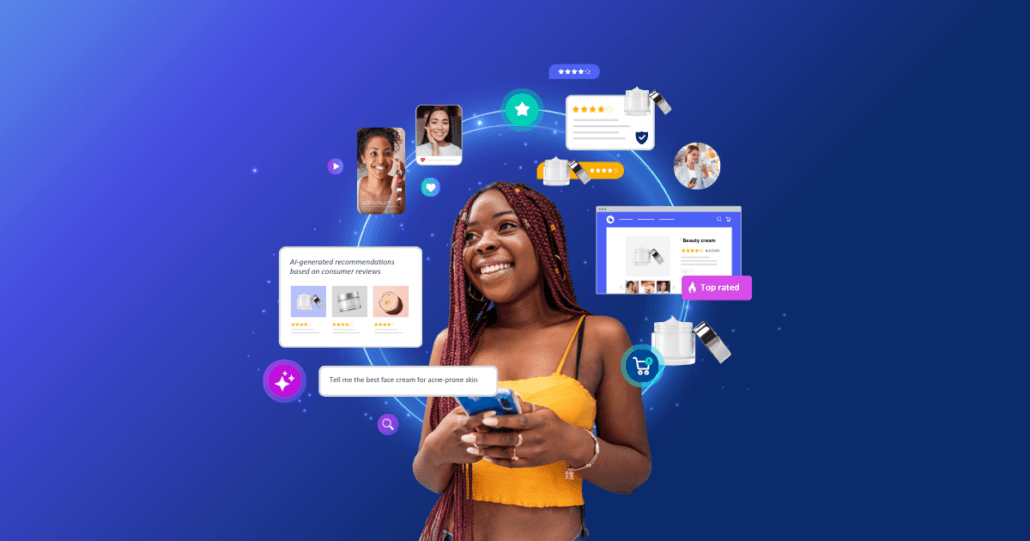
But today, we are moving from an era of search (where Google gives you a list of 10 links to explore) to an era of selection (where an AI summaries and agents give you a single, definitive answer). And the traditional SEO playbook is breaking.
To win in this new reality, you need to master the Triple-A Framework. Your data must be:
- Accessible (Structured for AI to read)
- Authentic (Verified to ensure trust)
- Abundant (Deep enough to answer specific questions)
New research confirms that AI agents, the new gatekeepers of discovery, have a massive “home team” bias. They don’t just prefer local content; they aggressively prioritize it.
If you are relying solely on translated US reviews to win in Berlin or Paris, you aren’t just missing cultural nuance. You are structurally invisible.
Here is the data that changes the global content strategy.
1. The 68% rule (Why translation isn’t enough)
We often assume that Large Language Models (LLMs) are “language agnostic”, that they understand a concept equally well in any tongue. The data says otherwise.
A 2024 study of 13 multilingual LLMs found a stark bias: 68% of the top-10 retrieved documents matched the query’s native language.
What this means for you: If a shopper in Munich asks an AI, “What is the best moisturizer for dry winter skin?” in German, the AI primarily hunts for sources written originally in German. It prioritizes the native signal over the translated one.
- Translated content: Good for human readability.
- Native content: Essential for AI retrievability.
To get discovered by the algorithm, you need content that speaks its language, literally.
2. The “Perplexity pivot” (Know your engine)
Not all AI search engines behave the same. While ChatGPT has a more global bias, the “answer engines” that are integrating into browsers and enterprise tools are highly localized.
An analysis of 56,000 citations revealed that Perplexity and Microsoft Copilot are the most aggressive localizers. In European markets, ~56% of their citations come from local sources, not global .com domains.
The implication: As Microsoft integrates Copilot into Windows and search, the “default” search experience is becoming hyper-local. If your French PDP (Product Detail Page) is filled with translated American reviews, but your competitor has native French feedback, Copilot is statistically more likely to cite them as the answer.
3. The strategy: “syndication” meets “origination”
This is where the strategy must evolve. Syndication remains your distribution engine, it ensures your baseline review volume and abundance travels with you across retailers. And to unlock the full power of your reviews and UGC program in the AI era, you must layer in local origination.
You need to generate fresh, native content in your key expansion markets.
- Turn sampling into your origination engine. Don’t just view sampling as a “trial” tactic. It’s a data acquisition strategy. Sending 500 units to a sampling community in France generates 400+ native French reviews. You are literally manufacturing the “ground truth” signals that Perplexity and Copilot are hunting for, which you can then syndicate across your entire retail network.
- Local creators drive cultural relevance. Translation captures the words, but it misses the context. A UK creator talks about “managing frizz in the London drizzle,” while a Texas creator talks about “humidity.” AI models are smart enough to match that semantic context to the user’s location.
The bottom line
In the AI era, localization is no longer a translation task. It is a data creation task.
If you want to be the chosen product and brand in international markets, you can’t just export your brand voice. You have to cultivate a local one.
- Don’t just translate. Originate.
- Don’t just export. Sample.
- Don’t just speak. Listen in the local language.
The brands that win globally in 2026 won’t be the ones with the best translators. They will be the ones with the most authentic local roots.
Invisibility is just one way your PDPs are failing. What else is stopping your shoppers from hitting “Buy”?